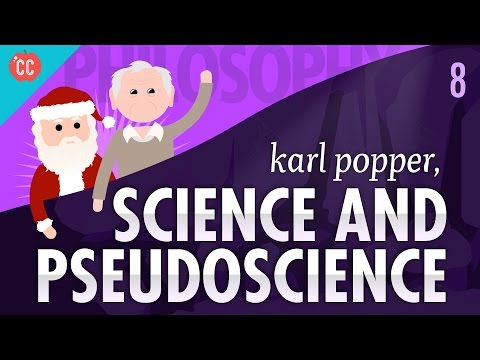
CrashCourse: 'Karl Popper, Science and Pseudoscience'
https://www.youtube.com/embed/-X8Xfl0JdTQ
Point: Karl Popper's 'paradox of tolerance' https://en.wikipedia.org/wiki/Paradox_of_tolerance Related: 'scientific method' https://en.wikipedia.org/wiki/Scientific_method Transcript: "But Popper would argue that it's only by seeking to disprove Santa's existence that you can demonstrate his unreality. So the question is, when we begin to test a theory, are we looking to confirm it, or dis-confirm it? This is the key point, for Popper – science dis-confirms, while pseudoscience confirms. He elaborated on this insight by establishing a series of distinct conclusions about science and knowledge. First, he said, it's easy to find confirmation of a theory if you're looking for it. Remember the presents under the tree? If you're looking for proof that Santa exists, you're not likely to keep searching for contradictory evidence after that. Second, confirmation should only count if it comes from risky predictions – ones that could actually destroy your theory. Because, Popper observed that every good scientific theory is prohibitive – it rules things out. This might sound strange, because no one wants to be wrong, but Popper says that every false belief we discover is actually good, because that gets us that much closer to believing only true things. Next, Popper argued that the only genuine test of a theory is one that's attempting to falsify it. So, if you were to test for Santa's reality, your method would require you to try to prove that he doesn't exist, rather than proving that he does. So, you stay up all night, waiting to catch him delivering his presents. This is risky, because if the person who actually shows up to put presents under the tree is your Dad, then you've destroyed the Santa hypothesis. On a very similar note, Popper also pointed out that irrefutable theories are not scientific. If it can't be tested, then your theory doesn't have much value. Like, you can only confirm that Santa is real by doing everything in your power to prove that he's imaginary, and then failing to do so. So you need to be tugging on Santa beards at the mall. You need to investigate reports of Santa sightings, and other weirdoes caught breaking into peoples' houses through their chimneys. If you want to be able to really trust in your belief in Santa, in a genuinely scientific way, you need to put your belief to the test, in every way you can imagine. This is where Popper says that you have earned the right to call a theory scientific. And finally, once you've disproven your theory, Popper said, you need to be willing to give it up. I mean, you can still cling to the Santa myth, even after catching your Dad putting gifts under the tree, by accepting his lie that Santa had dropped the gifts off earlier, and that he was just 'helping.' But, if you're a scientist, you're gonna have to be willing to let your beliefs go. Accept the evidence. Move on. And this is the modern scientific thinking that we accept today: Testable, refutable, falsifiable. You don't seek to prove scientific hypotheses right, you only prove them wrong."