np/SubjectivistEpistemology 
YouTube URL SubjectivistEpistemology bookmarklet Name / label / descriptive title

Jersey Flight: 'The Crisis of Subjectivist Epistemology'
Explanation: "Subjectivist epistemology assumes that it is the subject that creates meaning and imposes it on the object. The underlying idea of this philosophy is that how we perceive and understand reality determines and creates knowledge. The pluralist and plastic nature of reality is reflected in subjectivism, according to which social actors impose meaning on the world and interpret it as they see fit. Unlike objectivist researchers whose motto is ‘seeing is believing’, subjectivists’ beliefs determine what is seen" (2023).
Transcript: "The crisis of our time is a crisis of what we might call a 'subjectivist epistemology'. It goes like this, any information that contradicts what I feel to be true, makes me feel uncomfortable, or requires me to think, must be false. Any information that contradicts what I feel to be true or makes me feel uncomfortable or requires me to think, must automatically be false. What's happening is that individuals are contrasting information evidence reason they're pitting it against their own feelings of what is true against their own experience of reality."
Discussion: In simple terms, there is an objective reality, [Wikipedia] where meaning is understood to be objectively true. It is a situation where such truth is derived empirically (verified through direct observation, experimentation or sensory experience) [Wikipedia] or through pure logic/theory. It is a situation where such a truth has been arrived at through a logical-analytical process, which can be broadly characterised as 'scientific method' [Wikipedia] where hypotheses, which might challenge existing truths are tested and if found to be true, come to replace that, which was previously held to be true. Importantly, the consensus about what constitutes truth provides a common basis for discussion and debate. While our perceptions, emotions, opinions etc. can be understood to be subjectively true i.e. how we understand the world to be true (such as the sense that the weather is warm and pleasant or conversely hot and uncomfortable etc.) - this is part and parcel with being sentient/human, i.e. that how we experience/inhabit the world depends on factors which are specific to ourselves (which necessarily hold some truth). This contrasts with what can be understood to be a 'crisis of subjectivist epistemology' where such subjective truths have been mistaken for absolute, incontrovertible and universal, truths - despite evidence to the contrary.
Transcript: As 'Jersey Flight' outlines "if the information is uncomfortable we do not want it so we bring our subjectivist epistemology to bear as an authority to give us the kind of conclusion we want or to dismiss the information we don't like to dismiss the evidence we don't like to repudiate the rationality that we find distasteful we don't want to live in reality we want to live in our sub subjectivity the crisis that we face is the crisis of a subjectivist epistemology" https://www.youtube.com/embed/EJ3JYLzHw68?start=179
Quote: "Subjectivist epistemology ... holds that what constitutes knowledge depends on how people perceive and understand reality. Thus, reality is pluralistic (i.e., reality can be expressed in a range of symbol and language systems) and plastic (i.e., reality is stretched and shaped to fit the purposes of individuals) (Schwandt 1994; Pratt 1998; Powell 2001). People impose meaning and value on the world and interpret it in a way that makes sense to them (Crotty 1998; Pratt 1998). Whereas the motto of objectivism might be seeing is believing, the motto of subjectivism might be believing determines what is seen (Pratt 1998). ... For subjectivists then, 'we see the world as we are; that which we have inside, we see outside' (Pratt 1998:24). Subjectivism focuses on correspondence with the inner, rather than the outer, world and attempts to understand the knowledge, interests, purposes, and values of individuals; the meanings that constitute an action are as important as the action itself (Schwandt 2000). Subjectivists reject the idea that subject and object, observer and observed, or mind and world can be separated, assuming instead that each individual observes the world from a specific place of purpose and interest" (Moon, K. and D. Blackman, 2014, p.1172).
Bibliography: Moon, K. and D. Blackman (2014). 'A Guide to Understanding Social Science Research for Natural Scientists.' Conservation Biology 28(5): 1167–1177. [academic source] Moon, K., & Blackman, D. (2017, May 2). 'A guide to ontology, epistemology, and philosophical perspectives for interdisciplinary researchers'. Integration and Implementation Insights. https://i2insights.org/2017/05/02/philosophy-for-interdisciplinarity/ 'Subjectivist Epistemology'. (n.d.). Encyclopedia.com. Retrieved March 5, 2026, from https://www.encyclopedia.com/humanities/encyclopedias-almanacs-transcripts-and-maps/subjectivist-epistemology An Ultimate Guide to Epistemology. (2023, January 25). PhD Centre. https://phdcentre.com/phd-thesis-epistemology-guide/

Viral video: 'cat watches horror movie' (or, really just a moving string?)

Discussion: the clip has been constructed so that the cat is understood to be deeply immersed in the dramatic action of Alfred Hitchcock's 1960 film 'Psycho'. In doing so, the clip anticipates an audience who will interpret its meaning through a process of 'abductive reasoning' [Wikipedia] i.e. a 'best guess' heuristic. [Wikipedia]
Further to this: What is Abductive Reasoning? https://www.youtube.com/embed/zGgJYKEKCzI
About: https://www.theguardian.com/media/2016/may/13/viral-video-cat-horror-movie-james-corden-cyndi-lauper [commentary] [folksonomy]

Sahar Joakim: 'What is Epistemology?'

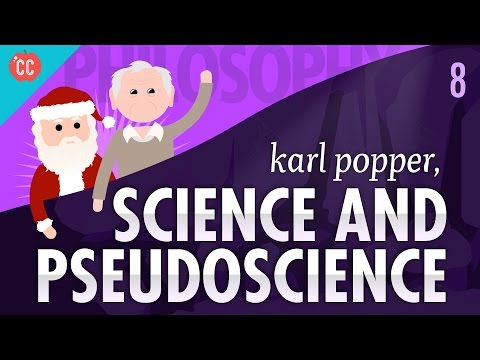
CrashCourse: 'Karl Popper, Science and Pseudoscience'

Point: Karl Popper's 'paradox of tolerance' [Wikipedia]
Related: 'scientific method' [Wikipedia]
Transcript: "But Popper would argue that it's only by seeking to disprove Santa's existence that you can demonstrate his unreality. So the question is, when we begin to test a theory, are we looking to confirm it, or dis-confirm it? This is the key point, for Popper – science dis-confirms, while pseudoscience confirms. He elaborated on this insight by establishing a series of distinct conclusions about science and knowledge. First, he said, it's easy to find confirmation of a theory if you're looking for it. Remember the presents under the tree? If you're looking for proof that Santa exists, you're not likely to keep searching for contradictory evidence after that. Second, confirmation should only count if it comes from risky predictions – ones that could actually destroy your theory. Because, Popper observed that every good scientific theory is prohibitive – it rules things out. This might sound strange, because no one wants to be wrong, but Popper says that every false belief we discover is actually good, because that gets us that much closer to believing only true things. Next, Popper argued that the only genuine test of a theory is one that's attempting to falsify it. So, if you were to test for Santa's reality, your method would require you to try to prove that he doesn't exist, rather than proving that he does. So, you stay up all night, waiting to catch him delivering his presents. This is risky, because if the person who actually shows up to put presents under the tree is your Dad, then you've destroyed the Santa hypothesis. On a very similar note, Popper also pointed out that irrefutable theories are not scientific. If it can't be tested, then your theory doesn't have much value. Like, you can only confirm that Santa is real by doing everything in your power to prove that he's imaginary, and then failing to do so. So you need to be tugging on Santa beards at the mall. You need to investigate reports of Santa sightings, and other weirdoes caught breaking into peoples' houses through their chimneys. If you want to be able to really trust in your belief in Santa, in a genuinely scientific way, you need to put your belief to the test, in every way you can imagine. This is where Popper says that you have earned the right to call a theory scientific. And finally, once you've disproven your theory, Popper said, you need to be willing to give it up. I mean, you can still cling to the Santa myth, even after catching your Dad putting gifts under the tree, by accepting his lie that Santa had dropped the gifts off earlier, and that he was just 'helping.' But, if you're a scientist, you're gonna have to be willing to let your beliefs go. Accept the evidence. Move on. And this is the modern scientific thinking that we accept today: Testable, refutable, falsifiable. You don't seek to prove scientific hypotheses right, you only prove them wrong."

Eli Pariser 'filter bubbles' (2011)

Synopsis: Eli Pariser talks about algorithmic content-editing, which has become a feature of social media (web application software and platforms) and the invisible processing of user data obscuring/limiting its transparency for its users.
Transcript: "Facebook isn't the only place that's doing this kind of invisible, algorithmic editing of the Web. Google's doing it too. If I search for something, and you search for something, even right now at the very same time, we may get very different search results. Even if you're logged out, one engineer told me, there are 57 signals that Google looks at -- everything from what kind of computer you're on to what kind of browser you're using to where you're located -- that it uses to personally tailor your query results. Think about it for a second: there is no standard Google any more." https://www.youtube.com/embed/B8ofWFx525s?start=115&end=155
Transcript: "In a broadcast society -- this is how the founding mythology goes -- in a broadcast society, there were these gatekeepers, the editors, and they controlled the flows of information. And along came the Internet and it swept them out of the way, and it allowed all of us to connect together, and it was awesome. But that's not actually what's happening right now. What we're seeing is more of a passing of the torch from human gatekeepers to algorithmic ones. And the thing is that the algorithms don't yet have the kind of embedded ethics that the editors did. So if algorithms are going to curate the world for us, if they're going to decide what we get to see and what we don't get to see, then we need to make sure that they're not just keyed to relevance. We need to make sure that they also show us things that are uncomfortable or challenging or important -- this is what TED does -- other points of view." https://www.youtube.com/embed/B8ofWFx525s?start=365&end=423
Consider (Simon): the above in relation to the naive optimism i.e. 'cyber-utopianism' expressed through the following http://newpractices.co.uk/cyberculture/#TPAO-lZ4_hU where Michael Wesch (2008) explains: "...and there's a lot more going on than just dancing. And you know, you think about the joy that people are expressing and the fun that they're having as they do this dance. And I like to think of it as more than just a dance, it's a celebration. It's a celebration of new forms of empowerment. You know, anybody with a webcam now has a stronger voice and presence. It's a celebration of new forms of community, and types of community that we've really never seen before, global connections, transcending space and time. It's a celebration of new and unimaginable possibilities. And you know, you can say this is all hype. Like these are just people dancing and having fun, but think about what they're dancing in front of. They're dancing in front of about a billion boxes in places all over the world that are networked together and allows us to connect in ways we've never connected before. And in fact, they can actually invent new ways to connect with each other and it's getting easier and easier to do so. And so that's what I like to think that this is really just a very important moment." https://www.youtube.com/embed/TPAO-lZ4_hU?start=289&end=332
Consider (Simon): The computer utopianism of Loren Carpenter [Wikipedia] et al. 'subconscious consensus' https://www.youtube.com/embed/I6EBpLfLHCA?start=508&end=688 as per http://newpractices.co.uk/cyberculture/#I6EBpLfLHCA;TRA5
Consider (Simon): homophily: 'birds of a feather flock together' http://newpractices.co.uk/cyberculture/#jykGYsrm1es;TRA4
Criticism: While compelling for its simplicity, the model is overly instrumentalist view of social media/technology - casting Internet/social media users as passive recipients of a unidirectional flow of meaning (reactive rather than proactive information subjects).
Discussion: The phenomenon of filtering content algorithmically (producing so-called 'filter bubbles' [Wikipedia] as Pariser explains) models a similar approach to that of 'market segmentation' [Wikipedia] - except, whereas market segmentation operates through defining and then allocating audiences/users to such categories - algorithmic sorting/grouping operates dynamically through filtering content on-the-fly according to the real-time interpretation of data/inputs/user-interactions. And so, the real issue has less to do with actual technology and more to do with how such 'dynamic categories' assume the sharing of common information contexts as per the notion of the 'public sphere'. [see] and the consequences for society for having different and potentially competing information contexts (especially, as they enable and justify the establishment of multiple subjectivist epistemologies).
Related: "The personally tailored, genuinely unique ‘newspaper’ selected privately from a data base–the ultimate outcome of the social and physical demassification of the newspaper as we now know it–offers neither physical, nor social continuity. Each individual output would be no more than that–an individual output. The juxtaposition of the senator and the pork bellies would then be not a composite, if oblique, social fact, but merely a result of personal serendipity" (John Seely Brown and Paul Duguid, p.24–25).
Related: "A 2024 study by SparkToro found that nearly 60% of Google searches end without anyone clicking through to a website, and the trend has accelerated since. By February 2026, Ahrefs found that queries triggering AI Overviews now see a 58% reduction in clicks. Google has been systematically inserting itself between you and the original source, answering questions with AI-generated summaries before you ever reach the page those answers came from. The results you do see are filtered through an algorithm that weighs your search history, your location, and the billions of dollars advertisers have spent to appear for particular queries. Two people searching identical phrases on the same day can get meaningfully different results without either of them knowing it. And because Google controls roughly 90% of the world's search traffic, most people have no frame of reference for what a less mediated search experience would even look like." (Goldin, H.L., 2026). See [skeet] for more.
Bibliography: Pariser, E. (2011). The filter bubble : what the internet is hiding from you. London, Penguin. [pdf] Seely Brown, J., & Duguid, P. (2026). "The Social Life of Information: Borderline Issues": UC Berkeley School of Information. https://people.ischool.berkeley.edu/~duguid/articles/Borderline_Issues.htm Goldin, H.L. (2026). Google Has a Secret Reference Desk. Here’s How to Use It. [online] Substack.com. Available at: https://cardcatalogforlife.substack.com/p/google-has-a-secret-reference-desk [Accessed 22 Mar. 2026].

Reportify: "Yes, he's an idiot with zero common sense, and no social skills, but he IS my son. I just hope he never goes into politics.?He'd be a disaster.

Example: 'a beluga whale escapes research facility and swims hundreds of miles back to her baby' [fact-checked] [Instagram]
Bibliography: Reuters Staff. (2020, April 17). "False claim: Donald Trump’s mother said he would be a disaster in politics". Reuters. [fact-checked] https://s.yimg.com/os/en/snopes_632/188f41f8db9386d7902c587b50d3a6f0 [jpg] [fact-checked] [fact-checked] [jpg] [fact-checked] [fact-checked]

The 'Spiral of Silence' theory

Point: "social media did not provide new forums for those who might otherwise remain silent to express their opinions and debate issues. Further, if people thought their friends and followers in social media disagreed with them, they were less likely to say they would state their views on the Snowden-NSA story online and in other contexts, such as gatherings of friends, neighbors, or co-workers. This suggests a spiral of silence might spill over from online contexts to in-person contexts, though our data cannot definitively demonstrate this causation. It also might mean that the broad awareness social media users have of their networks might make them more hesitant to speak up because they are especially tuned into the opinions of those around them" (Hampton, K., 2014).
Context: "Elisabeth Noelle-Neumann's [Wikipedia] name is closely connected to the 'spiral of silence' – a theory that reverberated far beyond the scientific community. Anchored in social psychology, the theory explains how sways in public opinion may come about, especially in morally and emotionally laden debates. Possibly because Noelle-Neumann's assumptions about the social influences on human behavior are controversial and contradict widely held views of the rational, autonomous individual, the spiral of silence counts among the most cited and replicated theories in social sciences" (Petersen, T., 2022).
Bibliography: Hampton, K., Rainie, L., Lu, W., Dwyer, M., Shin, I., & Purcell, K. (2014). "Social media and the 'spiral of silence.'" Pew Research Center: Internet, Science & Tech. https://www.pewresearch.org/internet/2014/08/26/social-media-and-the-spiral-of-silence/ Paluck, B. L. (2025, July). "What a ‘Spiral of Silence’ Can Do to a Democracy". The Atlantic. [digital archives] Petersen, T. (2022). 'Spiral of Silence | Elisabeth Noelle-Neumann'. Noelle-Neumann.de. https://noelle-neumann.de/scientific-work/spiral-of-silence/

ABC Australia (2012). Danielle Celermajer 'Hannah Arendt on the Political Realm'

Synopsis: "Hannah Arendt’s life describes a tragically typical twentieth century trajectory. Born in Germany and, fleeing the Nazis, she ended up in the United States, where she died in 1975. As a philosopher – a title she disclaimed – she insisted on the importance of thinking in the world and not trying to be above it and she thought that understanding the richness and variety of the world was more important than attaining a consistent view of it. This week, we look at a very worldly thinker" (Saunders, A., & Celermajer, D., 2012).
Context: Danielle Celermajer [academic source] "Professor of Sociology and Criminology at the University of Sydney, [Australia] Deputy Director of the Sydney Environment Institute and lead of the Multispecies Justice project. My research focus today is on Multispecies Justice, or how the concepts, practices and institutionalisation of justice needs to be transformed to take into account ecological realities and the ethical standing of all earth beings." https://profiles.sydney.edu.au/danielle.celermajer
Transcript: "Danny [Danielle Celermajer] how does [Hannah] Arendt [Wikipedia] characterise the political realm as she thinks it ought to be well her language is quite confusing because when she talks about politics anyone who listens to news radio and Australian parliament would have absolutely no idea what she's talking about. So she often has in her mind the 'demos' [Wikipedia] the Greek demos where free and equal citizens discuss what matters to them so politics is the realm in which we exchange our ideas and together in this context of what she calls plurality we come up with ideas about what we think about what we want to do it's the process of thinking together about the world that's really what politics is the process of thinking talking and acting together about the world so the idea of political life then is that we do not enact something which was laid down before us according to a template because if we do that we're just cogs in a machine well to her that's not politics that's administration and one of the criticisms that she had of contemporary or her contemporary politics is the idea that politics is about enacting what we already know to be the case is this for her an anathema of what the political life offers when she spoke about politics she really thought that that was the highest realm of what it was to be a human being was to join with your equals in this disclosive [sic] process I use disclosure as opposed to creative because she had a distinction between those two when we created something we had an idea in our mind of what we were creating when we disclose we bring something new into existence so when she spoke about the political life she actually thought that we were bringing something new into existence so when I come into a political conversation with my free and equal others I don't know what I'm going to say before I get there it emerges in the space that comes up between us totalitarianism as she understood it had its greatest evil or it's was most deleterious in the sense that it removed all space in which individual in community with others or in plurality with others was possible so because there was a blueprint of the correct form of life both in Nazism and in Stalinism [Wikipedia] any person who came into existence simply had to be coordinated as she liked to say with this movement forward into the inevitable perfection of humanity so there was no space in there for an individual to discover in the context of the world as it appeared to her or him what it was to think about the world or to bring the world into existence because the world's ideal type had already been established in both cases perhaps we should look at how she stands in relation to other political thinkers let's take the 17th century English philosopher Thomas Hobbes [Wikipedia] who basically held that our sovereignty our personal sovereignty depended more or less on getting other people out of the way on not being dependent upon other people's will how does her thoughts stand in relation to his? Well it's a wonderful contrast concept because that notion of freedom for Hobbes literally freedom in politics is an extension of freedom to be able to move to be able to push obstacles including other people out of our way. For Arendt it couldn't have been more different we only get to be free in relation to other free people or to free others so the notion that there is an individual who gets to be autonomous by virtue of expressing some pre-existing will that's not freedom to her. And what about the 18th century think of Jean-Jacques Rousseau, [Wikipedia] now Rousseau certainly had a notion of the 'public realm' [Wikipedia] but for him the public realm was the republic into which we individuals should be subsumed right so Rousseau then is on the other end of the spectrum of the individual freedom comes from the will of all or the general will rather than the will of the individual as it does for Hobbes but there is a important qualitative difference between the mass says Arendt would have read Rousseau or the will of all and the plurality in which individuals still exist they don't exist as the individuals that they would have been out of the context of others but they have to remain as individuals if the individual is simply subsumed in a new entity which is the all or the republic then freedom is similarly lost."
Criticism: "While both Habermas and Arendt regard public discourse as central to democratic politics, they differ fundamentally in their understanding of political legitimacy. Habermas emphasises rational consensus as a legitimising ideal, but the strain of populist pressures amplifies the framework’s limitations – namely, its susceptibility to power imbalances, risk of domination, and reliance on an imperfect mechanism of public opinion. In contrast, Arendt critiques the pursuit of consensus, arguing instead that legitimacy arises from the plurality of action and the participation of individuals in a shared public space. By reframing political engagement as an ongoing, unpredictable process rather than a quest for uniform agreement, Arendt offers a vision of the public sphere better equipped to withstand the polarising dynamics of contemporary populism" (Ngo, A., 2025).
Also: Giorgia Meloni + J. R. R. Tolkien (1954). 'The Lord Of The Rings' Kidology Zandile Powell
Bibliography: Saunders, A., & Celermajer, D. (2012, January 29). "The inconsistency of Hannah Arendt". In ABC listen. https://www.abc.net.au/listen/programs/philosopherszone/authenticity/3792574 Ngo, A. (2025). "Democracy on the Edge: Habermas, Arendt, and Populism’s Assault on the Public Sphere" – Cambridge Journal of Political Affairs. Cambridge Journal of Political Affairs. https://www.cambridgepoliticalaffairs.co.uk/2025/04/15/democracy-on-the-edge/ Arendt, H. (1962). 'The Origins of Totalitarianism'. Meridian Books. [pdf] [Wikipedia]

Lewis Waller (18 Oct 2017). 'Habermas: The Structural Transformation of the Public Sphere', Then & Now

Transcript: "Jürgen Habermas' [Wikipedia] first contribution to the thought of the Frankfurt School was The Structural Transformation of Public Sphere [Wikipedia] written in 1962. In it Habermas describes the development of a public sphere of thought that developed height of the salons and coffee shops of 18th century Europe before the weakening of monarchical powers that culminated in the French Revolution public affairs were decided mostly at the Kings Court as a tugging and pulling developed between the Monarchs the church and the developing poor to our businessman those bourgeoisie slowly won rights and protections for their newly acquired property which in turn developed into arguments about free speech and a free press that guaranteed a space the public opinion the Ascension of the public sphere coincided with the emergence of liberal philosophical thought from thinkers like Hobbes Locke and Kant for Hamas the public sphere is a bourgeois public sphere though because it excludes the poor and the uneducated it only made sense if you had the money to absorb or to contribute to the sphere in a meaningful way but even so throughout the course of the early development of capitalism and classical liberalism the public sphere and the quality of debate that took place in places like the penny coffee houses of London was notably egalitarian Lively rational the growth in long-distance trading required news about those new places of trade and a need for public relationships between people that had a stake in that growth of trade the relationships were horizontal between people of roughly the same social status rather than vertical between noblemen and commoners war Kings and his subjects so initially the public sphere was a thriving and positive place Habermas believes though that in the 1830s a shift started to take place guided by the Industrial Revolution and the rise of consumerism taking a Hague alien dialectic view Habermas believes that liberalism sought to save itself from its own contradictions by making way for a welfare states for those that capitalism wasn't looking after while at the same time the increasing size of corporations and the developments from mass media meant the demarcation between the public and the private spheres became blurred the pure and authentic nature of the salons and coffee houses and the independence of local newspapers dissolved Habermas argues that initially literary journals moral weeklies the writings of the men of letters ran unprofitably as hobbyhorses of the money aristocracy but eventually got swallowed by and became unfeasible because of the growing power of the publishing industry in the year of the revolution in Paris every political or politically minded man of any worth started a club or journal in May of 1789 as many as four hundred and fifty clubs and two hundred journals sprang up across Paris but the emergence of an authoritarian state stifled this explosion of free speech and the growth of advertising coerced editors into curating content by profit and little more publishing companies became accountable to the whims of the stock market Habermas argues that this change had a pernicious effect on the public's affairs ability to accommodate rational debate and questions of politics and morality came to be guided by economic interests and the indifferent flow of capital classical liberalism became unstable and government intervention was required for the formation of a welfare states the regulation of business and the overseeing of mergers and monopolies Habermas thinks that this had an effect on recreating those vertical relationships seen under feudalism public debates became dictated by public relations as government's business and advertising turn to psychology to influence the public with emotive ad campaigns advertising psychology has more to do with the emotive relationship of Lourdes over the serf than it should under a democratic thinking society the public sphere became less horizontal less of a rational critical environment for incubating ideas and became an area more heavily influenced by a hierarchical and bureaucratic system a good example of this is the way mass media operates in a single vertical direction there's no interaction between readers and editors the medium is simply consumed but a bomb-ass still has hope for the public sphere and highlights it has a fundamental mechanism of democracy a sphere that's the basis of democratic debate equality and rationality." https://www.youtube.com/embed/R1K46oK3xTU?start=30&end=359
Quote: Jürgen "Habermas argues that a bourgeois (middle-class) public sphere of intellectuals that helped to supplant medieval aristocracies and served an important political function in the eighteenth and early nineteenth centuries in countries such as Britain, France and Germany has become obsolete during the phase of late modernity or advanced capitalism" (Laughey, 2007, p.48).
Quote: Jürgen Habermas describes the 'public sphere' as a "network for communicating information and points of view (i.e., opinions expressing affirmative or negative attitudes)" (Habermas, J. r., 1996, p.360).
Criticism: While the theory is significant, its failure to account for broader cultural perspectives marks it out as being somewhat Eurocentric (Gunaratne, S. A., 2006). The notion of 'subaltern counterpublics' offers an alternative conceptualisation. Ioannis Kampourakis describes this phenomenon as: "discursive arenas that develop in parallel to the official public spheres and 'where members of subordinated social groups invent and circulate counter discourses to formulate oppositional interpretations of their identities, interests, and needs'. Nancy Fraser, coining the term from Gayatri Spivak’s 'subaltern' and Rita Felski’s 'counterpublic', argues that counterpublics are formed as a response to the exclusions of the dominant publics and that their existence better promotes the ideal of participatory parity" (Kampourakis, I., 2016).
Related: (certainly Eurocentric and likely, very much 'gendered' i.e patriarchal) "Spend three days rummaging through the chaotic, sprawling, sordid pit of information contained in the Epstein files, and you learn valuable lessons about how this modern global patriarchy operates: through flattery, the exchange of favours and occasional curt reminders of who owes what to whom. For women, these files offer an unprecedented chance to eavesdrop on conversations from which they are usually excluded. They provide salutary insights into what a set of distinguished global figures think and say about women when they assume the women aren’t listening. There are two groups of people in the Epstein files. The men: the billionaires, the tech entrepreneurs, the bankers, statespeople, politicians, leaders, people who need to be cultivated because they offer Epstein ways to strengthen his network of influence. And the women, who exist as insignificant plus-ones, or as people to whom he doles out money because they are providing him with services. Women feature as objects to be looked at and improved – teeth seen to, weight lost, STDs treated, features fixed. ('You might want to see a doctor about reducing the nose a little before you turn 23,' Epstein suggests to an unnamed woman in July 2017.) The emails show that Epstein is often irritated by the women" (Gentleman, A., 2026).
Quote: "Habermas sees the modern public sphere as, in many ways, the victim of its own success. As it expanded far beyond its original basis of educated male property-owners, material inequalities could no longer be set aside, but rather became the subject of public debate (1962 [1989: 127]). And this debate was no longer a matter of rational-critical analysis of state action by the assembled public, but of negotiation between interest groups which bypass public reason. Instead of the approximation of society to the ideal type, what emerged was an impoverished pseudo-public sphere, lacking its original capacity for rational-critical discourse, easily manipulated by states, corporations, and interest groups using the techniques of 'public relations' (1962 [1989: 176, 236]). Its role now, as in the feudal era, is to acclaim decisions which have already been made." [encyclopædia]
Quote: "The third major adjustment that media democratic theory needs to make is to take account of the development of organised democracy. When press theory was elaborated in the mid-nineteenth century, it was commonplace to think of the press as the sole intermediary between governed and governed, the latter conceived as an aggregation of individuals. For example, when in 1841 Thomas Carlyle famously dubbed the press the 'Fourth Estate', he made no reference to intermediary agencies between lawmakers and the people apart from the press. This convention has persisted in a surprising amount of scholarly commentary about journalism, especially in America, where it is not uncommon for a simple image of government, media and the public to be invoked. It is also embedded in the objectivity tradition of journalism, informing its understanding of how the newspaper should be organised. In this canon, impartial news briefs the individual citizen; view-based features provide a forum of debate shaping public opinion; and, in some versions, the editorial represents public opinion to government. The objectivity tradition also holds that the newspaper (and television channel) should sever all connection to sectional groups in order for its news to be impartial, its debate open and free and its allegiance to the general public unqualified. This conception is contrasted with debased forms of journalism, in which reporting is partisan and propagandistic and media discussion is distorted by predetermined agendas. The US, the home of objective journalism, is contrasted with more benighted countries where advocacy journalism prevails and where the media manipulate rather than empower the public" (Curran, J., 2011, p.78).
Transcript: "If we are to be rescued from global anarchy the city may turn out to be the agent of our salvation; that at least is the argument I want to try to make. The foremost challenge we face today is to establish institutions capable of addressing the multiplying cross-border problems of an interdependent world without surrendering democracy. To save ourselves from both anarchic and monopolistic forms of globalisation and to do that we need global democratic bodies that actually work. Nation-states have made little progress towards this kind of global governance. Too inclined by their nature to rival reaching mutual exclusion they seem went essentially indisposed to cooperation and incapable of establishing global common goods. Moreover and this is a challenge for us democracy is locked in the tight embrace of nation-states and there seems little chance either for democratising globalisation or for globalising democracy. As long as the flourishing of democracy depends on the survival and flourishing of warring nation states so what then can we do the path forward lies before us obvious but unchartered. Why not let city is the most networked and interconnected of our political associations defined above all by collaboration and pragmatism by creativity and multi-culture let's cities do what states cannot. If as Edward Glaeser has written in his new book about cities the strength that comes from human collaboration is the central truth behind civilisations success and the primary reason why cities exist both Glaser's right then surely cities can and should govern globally?" (Barber, B., 2012). https://www.youtube.com/embed/Um-pfPMzq0s?start=699
Related: 'epistemic homogeneity' and 'epistemic democracy' [Wikipedia]
Bibliography: Laughey, D., 2007. 'Key Themes in Media Theory'. Maidenhead: McGraw-Hill. [pdf] Curran, J. (2011). 'Media and democracy'. Oxford, Routledge. [pdf] Habermas, J. (1992). 'The Structural Transformation of the Public Sphere'. Polity Press. [pdf] Litsangou, P., Elmer, G., Langlois, G., & McKelvey, F. (2015). 'The Permanent Campaign, New Media, New Politics'. Transatlantica, 2. [academic source] [pdf] Singh, M. N. (2012). "Jurgen Habermas' Notion of The Public Sphere: A Perspective on The Conceptual Transformations in His Thought". The Indian Journal of Political Science, 73(4), 633-642. [academic source] Habermas, J. r. (1996). 'Between Facts and Norms: Contributions to a Discourse Theory of Law and Democracy' (W. Rehg, Trans.). MIT Press. Gunaratne, S. A. (2006). 'Public Sphere and Communicative Rationality: Interrogating Habermas's Eurocentrism'. Journalism & Communication Monographs, 8(2), 93-156. [academic source] Barber, B. (2012). "If Mayors Ruled the World", Long Now's Seminar Series, San Francisco. https://longnow.org/talks/02012-barber/ Addae, P., & Danquah, S. (2024). 'Brixton as a Locale of Subaltern Counter-Public Spheres'. [pdf] https://centric.org.uk/blog/health-activism-in-brixton/ Kampourakis, I. (2016). "Nancy Fraser: Subaltern Counterpublics." Critical legal thinking. [academic source] Gentleman, A. (2026, February 7). 'Sex and snacks, but no seat at the table: the role of women in Epstein’s sordid men’s club'. The Guardian; The Guardian. https://www.theguardian.com/us-news/ng-interactive/2026/feb/07/sex-and-snacks-but-no-seat-at-the-table-the-role-of-women-in-epsteins-sordid-mens-club

German Council on Foreign Relations (DGAP) (14 February 2026). 'The New Public Square Is a Screen: Rethinking Democracy in the Digital Sphere'

Transcript: "From Ukraine to Iran, from Africa to America, the screen has become the public square. Campaigns run on TikTok. Narratives travel instantly across countries. Politicians and human rights activists are competing against algorithms. But the same space also produces deep-fakes, coordinated disinformation, algorithmic suppression, and something even more subtle. The quiet reshaping of what people believe to be true. So today, we are not asking whether technology is good or bad for democracy. That question is too simple. We are asking something harder. What are the limits of a democracy that lives on privately owned platforms? Who controls the infrastructure of political ways? And how can we counteract the misuse of the public platforms?" https://www.youtube.com/embed/_cQBS_2e6Dc?start=1114
Bibliography: 'The New Public Square is a screen: Rethinking democracy in the digital sphere'. (2026n). Amerikahaus.De. https://www.amerikahaus.de/ausstellungen-und-veranstaltungen/2026-02-14-msc-the-new-public-square-is-a-screen-rethinking-democracy-in-the-digital-sphere

The Cottingley Fairies: Fact or Fantasy? (1976, BBC Archives)

Quote: "First intended only as an internal family joke, the photographs became subjects of international curiosity, debate and derision when subsequently championed by British theosophist Edward Gardner and literary celebrity and ardent spiritualist Arthur Conan Doyle as evidence for the existence of supernatural beings and, accordingly, the truth of their own alternative spiritual beliefs" (Ferguson, C., 2024).
Discussion: While this story appears to pivot around the problem of forensic examination methods and the availability of reliable evidence (as per the BBC Archives story), it's actually a story about 'belief' i.e. what do you believe - are fairies empirically real (so that their existence would allow them to be photographed)? And so, this boils down to a problem of 'confirmation bias', which isn't so dissimilar to the SFGMC choir case http://newpractices.co.uk/PostTruth/#ArOQF4kadHA;INS1, where for example it's possible to mistake untruth for truth as was famously the case with Sir Arthur Conan Doyle and his analysis of The Cottingley Fairies. [museum collection]
Example: "At a time when AI is becoming increasingly sophisticated, you may ask yourself: when is a photograph real or fake? Yet images have been manipulated, often with surprising ease, since the very beginnings of photography. In FAKE! you will explore 50 historical images from our collection that reveal creative and deceptive visual illusions." https://www.rijksmuseum.nl/en/whats-on/exhibitions/fake https://www.bbc.co.uk/culture/article/20260216-10-early-photographic-fakes-that-trick-the-eye
Example: https://www.boredpanda.com/fake-news-photos-viral-photoshop/ Weaponisation: http://trigg.gr/t/19225 Physiotherapist Angela Cullen Europe UK England Lancashire South Ribble Leyland
Bibliography: Ferguson, C. (2024). 'Power at Play in Paranormal History'. Science Museum Group Journal, Autumn 2024. [academic source] 'Exhibition FAKE! at the Rijksmuseum'. (2026). Rijksmuseum.nl. https://www.rijksmuseum.nl/en/whats-on/exhibitions/fake '30 Fake Viral Photos People Believed Were Real'. (n.d.). Bored Panda. Retrieved March 7, 2026, from https://www.boredpanda.com/fake-news-photos-viral-photoshop/

Marshall McLuhan 'The World is a Global Village' (1960, CBC TV)

Source: "Electronic gadgets have transformed the world into an interconnected tribe Marshall McLuhan calls a 'global village.'" https://www.cbc.ca/player/play/video/1.4701564
Quote: "The medium that supports this state of balance of senses is speech. Speech, however, is not just a transmitter. It is a message that reproduces a state that supports and promotes the actualisation of the possibilities contained in it. Hence, speech and the state of orality it creates is also a state of tribal closeness and community that meets the fundamental social needs of man" (Ciążela, A., & Treger, B., 2023, p.5).
Point: 'the medium is the message': https://www.youtube.com/embed/ydZXYqGrRyE?start=60 BBC Radio 4 (2015). 'The Medium is the Message': https://www.youtube.com/embed/Ko6J9v1C9zE?start=29
Quote: "The field is created spontaneously as a result of the development of communication between individuals participating in a given community, which is apparently only its tool. The problem, however, is that with the development of this communication it becomes something more than a tool, it becomes a medium that becomes independent from its producers, consolidates the principles that organize it, and directs the development of the community by actualizing the possibilities contained in it in the community‘s life. In this way, the field of a given medium is created, which determines its character and possibilities for the community" (Ciążela, A., & Treger, B., 2023, p.5).
Bibliography: Ciążela, A., & Treger, B. (2023). "'Global Village' Today. Marshall McLuhan’s Tribalism in the Perspective of the Development of the Humanities and Contemporary Civilisation". International Journal of Pedagogy, Innovation and New Technologies, 10, 3-13. [academic source] [pdf]

Howard Rheingold: 'Why the history of the public sphere matters in the Internet age' (2009)

About: Howard Rheingold [Wikipedia] talks about the relevance of the 'public sphere' in relation to the then, emerging pervasiveness of the Internet.
Context: https://people.well.com/user/hlr/howard.html
Transcript: "the term public sphere refers to that two-way flow of information in a democracy that enable citizens to have some reasonable idea of the workings of the state a notion that's sometimes called transparency and that enables citizens if if they are able to organise and to understand the issues of the day and to communicate about it to influence the policies of the state a a a general force known as public opinion the phrase the public sphere is most widely associated with the German political philosopher Jürgen Habermas and uh because Habermas writes in in the way that a a very serious philosopher does his work has not been widely disseminated among the the people who are interested in the future of the Internet and among journalists although I'm sure that anyone who is thinking about how democracy is going to fair in the Internet Age and and every journalist understands the particular role of communication media in and somehow uh balancing the citizens and the state the reason we go to the history of the public sphere going back to the English Civil War and the petitioners who made use of the new availability of print is that the period we're in today is is really a transitional period uh just as in the 16th and and 17th century print literacy was changing the way in which people communicated and the way in which people received information about the state the Internet is only a decade or two decades old in regard to its its spread among the world's population and institutions are evolving I think among Internet enthusiasts there's been a polarisation between the kind of utopian ideas of electronic democracy and and and the Very opposite the the notion that the ability of everyone to contribute has just uh entered so much noise into the system that that really although publishing and communication has been democratised the public sphere has been degraded there's also the the notion uh that as newspapers as the the primary way in which information about the state and public opinion emerged in early democracies as those institutions as the the the businesses that support newspapers are facing problems in fact may become extinct there's a real worry about again a kind of polarised idea of the mainstream media versus bloggers in their pyjamas I think in in both cases it helps to look at the history because the public sphere was not so much invented as evolved you talk about the mainstream media and bloggers in their pyjamas today you might well have been speaking about the uneducated vulgar petitioners in the days of the English Civil War and the the more refined Aristo aristocratic classes in both cases the literacies that emerged from a new medium a new technology began to spread and people armed with with those literacies were able to invent new forms of collective action and I think that what we're seeing today with the emergence of blogs and wikis of YouTube and many other ways in which citizens can contribute information misinformation and disinformation is the the beginning of an evolution so Habermas uh as I noted was a political philosopher and there's been an an entire School of discussion and critique of of his work um most most notably Nancy Fraser critiquing the idea of a bourgeois public sphere that's confined largely to bis to middle class white men and introduces the idea of 'publics'. I'm interested in the history because recently a historian by the name of David Zaret has written a book on the origins of democratic culture [(2000)] in which he said in effect it's too bad that the whole philosophy of the public sphere stems from the work of a political philosopher who whose work is largely cerebral certainly based on historical evidence but not empirical in the way that uh historians work is and Zarah said in effect if Habermas had the tools of a historian might have looked at source documents and found that instead of the Enlightenment philosophers who gathered in the coffee uh shops of London and uh Paris and Amsterdam and Philadelphia in the 18th century that in fact a far less uh aristocratic more vulgar less educated population of the various religious factions the the the religious dissidents in England who were intimately connected with English politics because of course if there was a Catholic or a Protestant on the throne and they and they changed sides a couple of times then the the people who dissented from from that reigning theology were were in trouble so it was really literally a life or death matter to talk about theological issues during this period and of course there really wasn't what we call transparency you could be hanged for revealing what was said in Parliament and of course the the state did not have to answer to the public there was really no influence of public opinion on the state somehow or another over a per period of a century or two that situation changed and we now have parliaments making policy rather than monarchies and presumably publics who influence policy now of course in the early 20th century Walter Lippmann [Wikipedia] questioned whether in America the the country uh he was living and and and in and writing about the citizens are are qualified are educated enough to make the decisions necessary for governing a a complex democracy the American public in Lippmann's terms were were sheep were easily misled and of course famously John Dewey [Wikipedia] responded in his review in The New Republic [Wikipedia] and later writings that in effect if our our citizens are are ignorant and easily misled then then perhaps we need better institutions for informing them we need better journalism and we need to educate them we need a better public education system so this this issue of whether and how citizens can communicate with the state and and know something about the state is something that's that's been a a live debate for quite some time I think that today as we're looking at the impact of Internet technologies the emergence of many to many communications whereas the the printing press was was a a really a broadcast medium in which a few people who had access to printing presses were able to influence and persuade many we now have an age in which for better and for worse every desktop connected to the Internet can influence and persuade are we going to to emerge from that that cacophony with some kind of coherent way of conveying the workings of the state without uh too much overt manipulation by the state and by powerful interested actors and are we going to see the emergence of new forms of public opinion formation that can influence policy I think that there are are strong signs uh that would enable you to argue either way today certainly the science of manipulating public opinion is much more sophisticated and and and much more well-funded today than it was in the time of Walter Lippmann and certainly we've seen with the Howard Dean [Wikipedia] campaign and then the Barack Obama campaign the ways in which citizen media and uh grassroots sometimes called 'netroots communications' and advertising have have been able to to merge with a kind of top- down political factions like the political parties that that uh VI for the the seat of power so I I think if you read Zaret and see how petitioners and the different factions in in parliament in England who were vying for power began to appeal uh to each other by saying that they had the backing of various factions of of uh unpower people uh through these pamphlets uh petitions and uh and beginnings of of newspapers they were appealing to what became public opinion uh Zaret also points out that the criticism of news media today whether it's the mainstream Media or the uh bloggers in their pyjamas reflects some of the same criticism that was levelled at the origins of the public sphere the idea is today is that the the news media being in many cases wholly owned by entertainment companies are are vulgar uh commercial and sensationalistic he points out that that this was true as well of the original newspapers that that evolved into what what many considered to be the fundamental communication medium of democracy so Paul Saffo [Wikipedia] the future forecaster has often said that you you ought to look twice as far backwards as you're trying to look forward Wards if you're trying to forecast something and I think if we're going to forecast the future of the public sphere we need to look at the way the current public sphere originally evolved over the last couple of centuries." https://www.youtube.com/embed/ZB4mlnTis2Y?start=52&end=794
Related: "For almost a century, this disentangling of geography and perspective inspired great optimism. While [Walter] Lippmann [Wikipedia] and [Harold] Lasswell [Wikipedia] penned their anxieties of a political age dominated by propaganda, John Dewey [Wikipedia] saw new democratic potential in the rise of despatialized mass media. Greater capacity for indirect communication brought on by the radio and mass printing (and later television and the internet) could obviate epistemic geography entirely, bringing about a 'Great Community' coterminous with the state. As he outlined in The Public and its Problems, increasing connectivity would increase the 'extensive and enduring consequences' individual actions had on 'others beyond those directly engaged in them.' More access to information would make the social implications of individual action clearer, bringing about a newfound collective interest in controlling the mutual unseen influence individuals had on one another (Dewey, J., 1927, p. 27). Geography would play a smaller and smaller role in how individuals perceived their group identities and group perceptions" (Allen, D. and J. Pottle, 2018, p.23).
Related: "This article explores a division that emerged between MySpace and Facebook among American teens during the 2006-­2007 school year. At the beginning of the year, a common question in American schools was: 'Are you on MySpace?' By the end of the year, the question had shifted to 'MySpace or Facebook?' As Facebook started gaining momentum, some teenagers switched from MySpace to Facebook. Others joined Facebook without having ever been on MySpace. Still others chose to adopt both. During this period, MySpace did not lose traction. Teens continued to flock to the site, opting for MySpace in lieu of or in addition to Facebook. To complicate matters more, some teens who had initially adopted MySpace began to switch to Facebook. Slowly, a distinction emerged. Those who adopted MySpace were from different backgrounds and had different norms and values than those who adopted Facebook. White and more affluent individuals were more likely to choose and move to Facebook. Even before statistical data was available, the language teens used to describe each site and its users revealed how the division had a race and class dimension to it. Given these dynamics and Kat’s notion of MySpace as ghetto, one way to conceptualize the division that unfolded is through the lens of white flight. In essence, many of the same underlying factors that shaped white city dwellers’ exodus to the suburbs – institutional incentives and restrictions, fear and anxiety, social networks, and racism – also contribute to why some teens were more likely to depart than others. What distinguishes adoption of MySpace and Facebook among American teens is not cleanly about race or class, although both are implicated in the story at every level. The division can be seen through the lens of taste and aesthetics, two value-­laden elements that are deeply entwined with race and class. It can also be seen through the network structures of teen friendship, which are also directly connected to race and class. And it can be seen through the language that teens – and adults – use to describe these sites, language like Kat’s that rely on racial tropes to distinguish the sites and their users. The notion that MySpace may be understood as a digital ghetto introduces an analytic opportunity to explore the divisions between MySpace and Facebook – and namely, the movement of some teens from MySpace to Facebook – in light of the historic urban tragedy produced by white flight. Drawing parallels between these two events sheds light on how people’s engagement with technology reveals social divisions and the persistence of racism" (Boyd, D., 2011).
Bibliography: Zaret, D. (2000). 'Origins of Democratic Culture: Printing, Petitions, and the Public Sphere in Early-Modern England', Princeton University Press. Boyd, D. (2011). 'White Flight in Networked Publics? How Race and Class Shaped American Teen Engagement with MySpace and Facebook'. In Race After the Internet. L. Nakamura and P. Chow-White, Routledge: 203–222. https://www.taylorfrancis.com/chapters/edit/10.4324/9780203875063-13/white-flight-networked-publics-danah-boyd [academic source] Allen, D. and J. Pottle (2018). 'Democratic Knowledge and the Problem of Faction', Knight Foundation. [pdf] Dewey, J. (1927). 'The Public and its Problems' (P. M. L. Rogers, Ed.). Henry Holt and Company. [eBook]

Pete Davis & Rebecca Davis (2023). 'Join or Die' (trailer)

About: the film centres on Robert Putnam's influential book 'Bowling alone' (2000) [Wikipedia] and the decline in 'civic engagement' [Wikipedia] and 'social capital'. [Wikipedia] in the US from the mid-20th century onwards. This is positioned in relation to the dramatic upswing in such engagement from the late 19th century (until the mid-20th century) and its consequence for the Gilded Age, [Wikipedia] which was famously characterised by massive wealth disparity and disenfranchisement e.g. Periodization Gilded Age
Point: "The norms and networks of civic engagement also powerfully affect the performance of representative government. That, at least, was the central conclusion of my own 20–year, quasi–experimental study of subnational governments in different regions of Italy. Although all these regional governments seemed identical on paper, their levels of effectiveness varied dramatically. Systematic inquiry showed that the quality of governance was determined by longstanding traditions of civic engagement (or its absence). Voter turnout, newspaper readership, membership in choral societies and football clubs––these were the hallmarks of a successful region. In fact, historical analysis suggested that these networks of organized reciprocity and civic solidarity, far from being an epiphenomenon of socioeconomic modernization, were a precondition for it. ... For a variety of reasons, life is easier in a community blessed with a substantial stock of social capital. In the first place, networks of civic engagement foster sturdy norms of generalized reciprocity and encourage the emergence of social trust. Such networks facilitate coordination and communication, amplify reputations, and thus allow dilemmas of collective action to be resolved. When economic and political negotiation is embedded in dense networks of social interaction, incentives for opportunism are reduced. At the same time, networks of civic engagement embody past success at collaboration, which can serve as a cultural template for future collaboration. Finally, dense networks of interaction probably broaden the participants' sense of self, developing the 'I' into the 'we,' or (in the language of rational–choice theorists) enhancing the participants' 'taste' for collective benefits" (Putnam, R., 1995, pp.65–78).
Related: Sherry Turkle (2011). 'Alone Together' https://www.youtube.com/embed/MtLVCpZIiNs?start=498 as per https://newpractices.co.uk/PostTruth/#MtLVCpZIiNs
Bibliography: Davis, P., & Davis, R. (Directors). (2023). 'Join or Die'. [imdb] Putnam, R. D. (2000). 'Bowling alone'. New York, Simon & Schuster. [Worldcat] Putnam, R. D., & Garrett, S. R. (2020). 'The upswing : how America came together a century ago and how we can do it again'. Simon & Schuster. [Worldcat] Putnam, R. (1995). "Bowling Alone: America’s Declining Social Capital". Journal of Democracy, 6(1), 65–78. [academic source] [folksonomy]

Frankie McNamara: 'People who read books on The Tube' (2025)

Context: "I first met Frankie McNamara unexpectedly, thanks to my For You page on TikTok. A twenty-something Irish native, McNamara's series of 'cultural observations' dissect everyone from Swifties to Gen Z to young men who wear North Face puffers. Conveyed with an unwaveringly flat affect, his well-researched videos are recorded in public alongside individuals who match the given description. Dozens of commenters refer to him as this generation's David Attenborough, although I wouldn't peg him as a biologist. Cultivating a largely European audience, his account has amassed nearly half a million followers and over 43 million views" (Tauszik, B., 2024).
Transcript: "Hello and welcome to this episode of Frankie's Cultural Observations. Today we're going to be analysing people who read books on the tube. Society used to be obsessed with character. Now all we care about is personality. No longer in a state of becoming.[Wikipedia] We're auditioning, auditing our everyday lives to appeal to people who aren't even looking at us because they have their AirPods in. So the commute home becomes a casting couch for the romantic lead in a novel that doesn't exist. And now finally I'm the one who's reading them. For these main characters, what's inside the Marxist literature they're pretending to understand is irrelevant. All that matters is what it signifies.[Wikipedia] They're not enjoying the book. They're enjoying the power of knowing you might be watching them. These 'tubermensch' [Wikipedia] are performing spectacle, propagating a fantasy, building the blueprint for a life that isn't real. Because they're not European, they're English, and England is no longer in Europe. That, that's pretty European! People who read books on the tube don't have the power to alter their economic conditions. When the future got cancelled,[Wikipedia] they didn't fall apart. They made their lives look aesthetic because it was all they could do. Staring longingly at a book they definitely aren't reading and wondering how hot they look right now. Despite being stuck on page two for the duration of their journey, nothing's going into their brain. They're not consuming the book. They're consuming the image of intellect on public display in the hopes that someone on the Elizabeth line would fall in love with them, which makes them more like a sex ornament with a superiority complex than an old soul with an inner life. In the attention economy, [Wikipedia] public transport becomes a sight of lifestyle branding. [Wikipedia] All quiet reflection gets muted and transformed into theatre. They fetishise their own isolation and act like no one's ever felt as alienated as they do. But alienation is a common experience that everyone shares. It's just being repackaged to trick you into thinking you're the only one who feels it because you're too deep and no one understands you. Whether the mask you wear is a Penguin Classics book seller, the gram in your pocket, or the phone that needs to be surgically removed from your hand, melancholia is not a you problem. It's mass-produced and everyone's buying it. In the performance of self, nothing escapes the commodity. This isn't a train journey for them. It's labour, not of the mind or the body, but of their presence. This is the work of being watched. A craft they've mastered after years of trying to look interesting on public transport, performing to an audience already looking away, too disinterested to even reject them. They don't just take the tube, they work it. When romantic introspection becomes their identity, and every silence demands a crowd, they mind the gap between the person they are and the person they're trying to become. People who read books on the tube engage in impression management [Wikipedia] to control how they're viewed by the other passengers. Their identity isn't fixed. It's assembled. A highlight reel of their most desirable traits for public consumption, which is usually just a cardigan and a copy of Das Kapital. [Wikipedia] Life is no longer for living. It's for broadcasting, live streaming, endlessly posting into the abyss to rebrand the ruins of a revolution they were never a part of. These are not books. They're portable billboards with words too big to understand. So these novels aren't meant to be read, they're meant to be worn. With the death of third spaces, [Wikipedia] the tube is one of the only places where you're forced to stand close to people. But closeness isn't connection. It's choreography. You're not allowed to speak. You shouldn't make eye contact. And you're definitely not supposed to be filming. Cognisant of all the social etiquette to remember, everyone performs civility, pretending not to notice each other while hyper aware of being seen. So readers retreat into the brick they pulled out of their tote bag to maintain the fragile illusion that they're still the ones writing their own story. The panopticon [encyclopædia] is no longer in the prison tower. It's on your phone camera. You might not be watched, but you behave as if you are just in case. This is the new performance of the downwardly mobile. That's cultural capital [Wikipedia] for people who can't afford their own home but can afford a book written by Sally Rooney. [Wikipedia] The American dream is dead, but we still stream selling sunset and self-s surveillance, internalising the gaze [Wikipedia] until it becomes a wobbly monument to a freedom that no longer exists. And when they reach their station, they put the book down, signalling the end of the performance. You're tuning in to notes from the underground. " Observation: "People who read books on the tube engage in impression management to control how they're viewed by the other passengers. Their identity isn't fixed. It's assembled. A highlight reel of their most desirable traits for public consumption, which is usually just a cardigan and a copy of Daz Capital. Life is no longer for living. It's for broadcasting, live streaming, endlessly posting into the abyss to rebrand the ruins of a revolution they were never a part of." https://www.youtube.com/embed/vN6ufdjsVCQ?start=167&end=195
Bibliography: Tauszik, B. (2024, January 17). "TikTok’s Frankie McNamara on Viral Fame". Paper Magazine. https://www.papermag.com/frankie-mcnamara-tiktok McNamara, F. (2025, May 4). 'People Who Read Books On The Tube' [YouTube]. Retrieved from https://www.youtube.com/embed/vN6ufdjsVCQ [channel] [imdb]

Jason Selvig, Davram Stiefler [The Good Liars] (8 June 2026). 'Rededicate 250'

Criticism: While 'vox pop' interviews [Wikipedia] can be a useful way of collecting insight (which uses a random, purposive [pdf] selection measure), they are prone to bias. For example, compare how impartial this The Good Liars [channel] interview is with those of the US conservative dogmatist Ami Horowitz - where he intentionally sets out to use his interviews as fuel for his own agenda http://trigg.gr/t/24410 Vox Pop
Related: 'The Identity Theory of Truth' [encyclopædia] Gottlob Frege [Wikipedia]
Bibliography: Selvig, J., & Stiefler, D. (2026, June 8). 'Rededicate 250 in DC - Part 2'. The Good Liars. https://www.youtube.com/embed/NRUNoeU4OPo

BBC News | Orson Welles: The 'alien invasion' that fooled America

Transcript: "Four or five years later, I was on the air doing a show. I was in the midst of some hymn of praise to the American cornfields, or something of the kind, when suddenly a gentleman darted into the radio studio, held up his hand and said, 'We interrupt this broadcast to bring you an announcement. Pearl Harbor has just been attacked.' Of course, this very serious and terrible news was never believed. Not for hours, by anybody in America, because they all said, 'Well, there he goes again. Really? Rather bad taste. It was funny once, but not a second time.' I suppose we had it coming to us because, in fact, we weren't as innocent as we meant to be when we did the Martian broadcast. We were fed up with the way in which everything that came over this new magic box, the radio, was being swallowed. People, you know, do suspect what they read in the newspapers and what people tell them. But when the radio came, and I suppose now with television, anything that came through that new machine was believed. So, in a way, our broadcast was an assault on the credibility of that machine. We wanted people to understand that they shouldn't take any opinion pre-digested, and they shouldn't swallow everything that came through the tap." https://www.youtube.com/embed/BkG70_wa4a8?start=118
Criticism: "As this clip in the BBC Archive reveals, when asked about the broadcast afterwards, Welles, ever the raconteur, made a big claim about the lasting impact his show had on shaping public opinion. He recounted how, a few years later, news broke that Japan had launched a surprise attack on the US base in Pearl Harbor during a patriotic performance he was giving on radio. 'I was in the midst of some hymn of praise to the American cornfields or something of the kind,' he recounts, 'when suddenly, a gentleman darted into the radio studio, held up his hand, and said, 'We interrupt this broadcast to bring you an announcement: Pearl Harbor has just been attacked.' And of course this very serious and terrible news was never believed. Not for hours, by anybody in America, because they all said, 'Well there he goes again, really, rather bad taste, it was funny once, but not a second time'.' In the years since, there has been much debate about whether the level of panic the broadcast actually caused has been overstated, or indeed how many people actually heard the broadcast, as opposed to reading the newspaper reports about it. But regardless, it remains a landmark moment in broadcast history, and a testament to the power of storytelling to capture the imagination of an audience" (Burke, M., 2023).
Bibliography: Burke, M. (2023, October 30). “I had no idea I’d become a national event”: Orson Welles on the mass hysteria of The War of the Worlds. Bbc.co.uk; BBC. https://www.bbc.co.uk/culture/article/20231027-behind-the-broadcast-orson-welles-on-the-mass-hysteria-of-the-war-of-the-worlds

CNNNN - The Chaser Non-Stop News Network - Series 2 - Episode 5

Costa Botes & Peter Jackson (1995). "Forgotten Silver"

About: "The myth of Colin McKenzie took television viewers by storm, prompting scores of letters from people enraptured by the discovery of these early New Zealand film gems. When Forgotten silver was exposed as a hoax the following day, those who had been taken in were either amused or distressed by Jackson and Botes' skilful deception..." (Anon, 24 May 2024). [Government]
Context: Costa Botes (2000). 'Behind the Bull' [NZ On Screen] [Government]
More: The film leverages patriotic sentiment about Richard Pearse's early aviation experiments [Wikipedia] to give the deception credence.
Scene: Fakery through invoking the 'zoom and enhance' trope, commonly used in crime shows: https://www.youtube.com/embed/H7_qDDjRyXQ?start=80 Duncan Robson's Let's Enhance (2009) 'supercut' cut-up for example, parodies the convention [see]
Bibliography: 'Forgotten silver film hoax screened', URL: [Government], (Manatū Taonga — NZ Ministry for Culture and Heritage), updated 24 May 2024. Botes, C., & Jackson, P. (1995). 'Forgotten Silver' P. Jackson; Television New Zealand. [Government] https://www.youtube.com/embed/FtGhzNtttds?start=437 David Bordwell 'Film Forgery: Observations on Film Art' https://www.davidbordwell.net/blog/2007/03/25/film-forgery/ Giombini, L. (2021). 'Music from beyond (or how to deal with a musical forgery)'. Lebenswelt. Aesthetics and philosophy of experience. [academic source] [pdf] Robson, D. (2009). "Let's Enhance". ACMI Australian Centre for the Moving Image. Available at: https://www.acmi.net.au/works/113842--lets-enhance/ [Accessed 24 Jan. 2026]. MOTAT. (2020). 'Richard Pearse and his remarkable hybrid plane'. MOTAT | New Zealand Museum of Transport and Technology. https://www.motat.nz/collections-and-stories/stories/The-Richard-Pearse-Utility-Plane/

Duncan Robson (2009). "Let's Enhance"

About: Fakery through invoking the 'zoom and enhance' trope, commonly used in crime shows. In this sense, Duncan Robson's "Let’s Enhance" (2009) 'supercut' cut-up parodies the convention, [video clip] which Costa Botes and Peter Jackson also masterfully deploy in their "Forgotten Silver" (1995) [see]
Discussion: The trope employs a 'magnification metaphor' - where such imagery is assumed to have detail, which is beyond the range of human sight (and so, is able to be revealed through a process of 'magnification and enhancement'). Importantly, the metaphor assumes the authority technology (as a type of 'techno-utopianism') [Wikipedia] - bestowing it with near magical capabilities of (image fidelity) transformation.
Bibliography: Robson, D. (2009). "Let’s Enhance". ACMI Australian Centre for the Moving Image. Available at: https://www.acmi.net.au/works/113842--lets-enhance/ [Accessed 24 Jan. 2026]. Botes, C., & Jackson, P. (1995). 'Forgotten Silver' P. Jackson; Television New Zealand. [Government] https://www.youtube.com/embed/FtGhzNtttds?start=437

Space Force "Can you zoom in on the exhaust mount? Enhance! Enhance! That's not how it works in real life."

The Newsroom (2012) "America is not the greatest country in the world anymore..."

Quote: Dialogue written by Aaron Sorkin [imdb] "And [to the conservative panelist] with a straight face, you're going to tell students that America's so starspangled awesome that we're the only ones in the world who have freedom? Canada has freedom, Japan has freedom, the UK, France, Italy, Germany, Spain, Australia, Belgium has freedom. Two hundred seven sovereign states in the world, like 180 of them have freedom. And you—sorority girl—yeah—just in case you accidentally wander into a voting booth one day, there are some things you should know, and one of them is that there is absolutely no evidence to support the statement that we're the greatest country in the world. We're seventh in literacy, twenty-seventh in math, twenty-second in science, forty-ninth in life expectancy, 178th in infant mortality, third in median household income, number four in labor force, and number four in exports. We lead the world in only three categories: number of incarcerated citizens per capita, number of adults who believe angels are real, and defense spending, where we spend more than the next twenty-six countries combined, twenty-five of whom are allies. None of this is the fault of a 20-year-old college student, but you, nonetheless, are without a doubt, a member of the WORST-period-GENERATION-period-EVER-period, so when you ask what makes us the greatest country in the world, I don't know what the fuck you're talking about?! Yosemite?!!! We sure used to be. We stood up for what was right! We fought for moral reasons, we passed and struck down laws for moral reasons. We waged wars on poverty, not poor people. We sacrificed, we cared about our neighbors, we put our money where our mouths were, and we never beat our chest. We built great big things, made ungodly technological advances, explored the universe, cured diseases, and cultivated the world's greatest artists and the world's greatest economy. We reached for the stars, and we acted like men. We aspired to intelligence; we didn't belittle it; it didn't make us feel inferior. We didn't identify ourselves by who we voted for in the last election, and we didn't scare so easy. And we were able to be all these things and do all these things because we were informed. By great men, men who were revered. The first step in solving any problem is recognizing there is one—America is not the greatest country in the world anymore." https://speakola.com/movie/jeff-daniels-sorkin-newsroom-2012
Note: Mention of the 'NEA' is seemingly the National Endowment for the Arts [Wikipedia]
Bibliography: Sorkin, A. (2012). 'We Just Decided To'. In G. Mottola, The Newsroom. HBO. [imdb]

Deux ou trois choses que je sais d'elle [2 or 3 Things I Know About Her] (1967)

About: Jean-Luc Godard famously references Ludwig Wittgenstein's "The Limits of My Language Mean the Limits of My World" hypothesis in this scene, as per Wittgenstein's 'Tractatus Logico-Philosophicus' (1921). [eBook]
Transcript: "Since I cannot escape the objectivity that crushes me, nor the subjectivity that exiles me, since I am permitted neither to rise to the level of being nor to fall into nothingness, I must listen, I must look around me more than ever at the world, my fellow human being, my brother, the world alone today, where revolutions are impossible, where bloody wars threaten me, where capitalism is no longer very sure of its rights and the working class is in retreat, where progress, the lightning-fast progress of science gives the future century an obsessive presence, where the future is more present than the present, where distant galaxies are at my doorstep, my angel, my brother, where does it begin? But where does what begin? God created the heavens and the earth, of course, but that's a bit cowardly and easy. We should be able to say better, to say that the limits of language are those of the world, that the limits of my language are those of my world, and that in speaking I limit the world, I end it, and that death, one day, logical and mysterious, will come. Abolishing this limit means there will be neither question nor answer; everything will be blurred. But if by chance things become clear again, it can only be with the emergence of consciousness. Everything will follow from there."
Concept: "It is because we have this language that we come to have this world, not before or after we use the language, but with and while we use it. The imposition is logical, not chronological. To assert that the limits of my language mean the limits of my world is to assert that language is not a coat or map which we make to fit some previously established limit but that it is an activity which is bound up with the development of these limits themselves" (Martland, T. R.,1975, p.20).
Bibliography: Martland, T. R. (1975). "On 'The Limits of My Language Mean the Limits of My World'" The Review of Metaphysics 29(1): 19–26. [academic source] [academic source]

Valerie Alexander (2018). 'How to Outsmart Your Own Unconscious Bias'. In TEDxPasadena

Example: [UK National Health Service]
Bibliography: Alexander, V. (2018). 'How to Outsmart Your Own Unconscious Bias'. In TEDxPasadena. https://www.youtube.com/embed/GP-cqFLS8Q4

The Guardian (1986). 'Points of View' TVC

Messaging (allusions): The ad uses a metaphor about a 'picture in parts', which when its metaphorical pieces are combined, form a discernible whole (akin to someone completing a jigsaw puzzle). The metaphor is told through a narrative about a skinhead [Wikipedia] who saves the archetypal 'man on the Clapham omnibus' [Wikipedia] from being crushed by a load of bricks, which are seemingly in the process of being hoisted to the building construction above. In it, multiple perspectives i.e. metaphorical 'picture parts' are shown - each depicting different perspectives on the same scene - two viewpoints, which offer up plausible but incomplete interpretations (constrained by the limitations of their vantage points); and a third, objective (seemingly omniscient) point-of-view, which the ad claims The Guardian has particular authority over i.e. that the newspaper has access to the the metaphorical 'discernible whole' and so, the truth, which it tells is therefore, absolute and incontestable. Note that by inference, the truth, which other news sources provide is necessarily only partly true - constrained by their respective, limited vantage points.
About: discussion about this ad and the contemporary state of the advertising industry [LinkedIn]
Related: The Guardian's ad was played out in reality in 2020 when Donald Trump shared the following clip, which CNN labelled as 'manipulated media' http://trigg.gr/t/21267
Media: additional version of The Guardian ad [channel] [video clip]
Bibliography: Swainger, H. (2016, March 1). 'Television adverts'. The Guardian. [digital archives] Allen, T., & Paul. (2020, June 17). "My Most Immortal Ad: Toby Allen & Paul Weiland Dissect The Guardian’s 'Points of View'" | LBBOnline. Lbbonline.com; Little Black Book. [trade magazine]

Sarah Polley (2012). 'Stories We Tell'

Synopsis: "This feature documentary is an inspired, genre-twisting film directed by Oscar®-nominee Sarah Polley. Polley's playful investigation into the elusive truth buried within the contradictions of a family of storytellers paints a touching and intriguing portrait of a complex network of relatives, friends, and strangers." https://www.nfb.ca/film/stories_we_tell/
Quote: "This conflict between Sarah Polley and her father over the direction of the film and her approach to storytelling is also emblematic of wider debates in social theory, epistemology, and ontology about narratives and meaning-making as representational or performative (Mauthner 2012; Somers 1994; Thrift 2008; Winthereik and Verran 2012). For her biological father, there is a true story and it can be represented; indeed, at one point in the film, he looks into the camera and says that 'the crucial function of art is to tell the truth, to find the truth'. Polley's view coheres more closely with a performative approach to stories where' it is through narratives and narrativity that we come to know, understand, and make sense of the social world and it is through narratives and narrativity that we constitute our social identities' (Somers 1994, 606)" (Doucet, A., 2015).
Further to this: https://u.osu.edu/english6778autumn2020/2020/11/03/truth-and-fiction-in-documentary-film-stories-we-tell/
Media: review copy of the film [site archive] [site archive]
Bibliography: Doucet, A. (2015). 'Ontological narrativity and the performativity of the Stories We Tell Stories We Tell'. Visual Studies, 30(1), 98-100. [academic source] [pdf] Anderst, L. (2013). "Memory's Chorus: Stories We Tell and Sarah Polley's Theory of Autobiography". Senses of Cinema(69). https://www.sensesofcinema.com/2013/feature-articles/memorys-chorus-stories-we-tell-and-sarah-polleys-theory-of-autobiography/ Ross McElwee (1986). "Sherman's March: A Meditation on the Possibility of Romantic Love In the South During an Era of Nuclear Weapons Proliferation" https://www.youtube.com/embed/RnohMWYXeZ4?start=60 'Stories We Tell'. (2012). Mongrel Media. http://www.mongrelmedia.com/index.php/filmlink?id=0d8abcae-32d9-451b-87a5-effc09b500f0

Frozen Planet (2011)

Argument: "Well, [cheating] is the charge now levelled at Attenborough and his team after a newspaper chanced to learn that the wondrous scene of a polar bear giving birth in Frozen Planet was not filmed in an icy burrow in the Arctic, as the programme seemed to imply, but in a plaster den in a Dutch zoo.[Wikipedia] Sir David, now 85, defended the scene saying: 'If you had tried to put a camera in the wild in a polar bear den, she would either have killed the cub or she would have killed the cameraman.' Mark Thompson, BBC director-general, told MPs that research had revealed that viewers did not want transcendent moments to be ruined by clunky, 'here’s one we prepared earlier' captions" (Pearson, A., 2011).
Argument: "Some viewers reportedly said they felt cheated by the episode, which did not make the distinction explicit during broadcast. However, the BBC deny any wrongdoing or deception, saying that the Frozen Planet website clearly states that the shots were taken from a zoo, and explains in detail why and how the shots were not filmed in the wild" (Thompson, H., 2011).
Criticism: The furore resulting from the film crew's decision to film the sequence of the polar bear giving birth in a Dutch animal park [Wikipedia] implies that doing so, jeopardises the authenticity of the documentary episode/series (and by extension, credibility of the David Attenborough and the production team) when clearly, the aim was to offer a fact-based narrative, which is plausible and believable. In this sense, the criticism clearly says about the expectations of such audiences for creating such television.
Bibliography: Spillenger, P., & Attenborough, D. (2011). 'Frozen Planet: Winter' (No. 5). BBC. [media archives] (jump to: 24:30 to 28:00) Fothergill, A. (2011). 'To the Ends of the Earth' (Season 1, Episode 1). In P. Spillenger, Frozen Planet. [media archives] 'The newest polar bear in the world'. (2011). [BBC] [imdb] Pearson, A. (2011, 14 December 2011). 'Fake? Sir David Attenborough is a wonder of the world'. The Telegraph. https://www.telegraph.co.uk/culture/tvandradio/8957122/Fake-Sir-David-Attenborough-is-a-wonder-of-the-world.html Hasan, L. (2011, 12 December 2011). 'Polar Bear Video Lands BBC in Hot Water'. https://abcnews.go.com/blogs/headlines/2011/12/fakery-or-bending-the-truth Thompson, H. (2011, 20 December 2011). 'Polar bear controversy'. YouGov. https://yougov.co.uk/politics/articles/2656-polar-bear-controversy

Nanook of the North (Flaherty, 1922)

Comment: 'Nanook of the North' (1922) might be best categorised as a 'docudrama' rather than a documentary because of its use of staged elements. The film is criticised for being a case (example) of what is known as 'salvage ethnography' [Wikipedia], which involves the exploitation of Indigenous culture and artefacts in the service of perspectives and agendas of colonisation.
Scene: staged 'awaking/morning' scene, which was filmed in an igloo with the roof removed (to compensate for low light conditions and the limitations of available film stock): https://www.youtube.com/embed/lkW14Lu1IBo?start=2944&end=3170
Scene: this scene (of a family of 5 fitting into a single-person kayak) is perhaps more a curiosity than anything else (and perhaps, is more a 'construction/fabrication' than an example of authentic Inuit travelling/transport practices): https://www.youtube.com/embed/lkW14Lu1IBo?start=299
Criticism: "The seminal 1922 silent documentary presented itself as a seemingly observational portrait of an Inuk man, Nanook [whose real name was Allakariallak], and his family and their way of life in the frozen north of Canada as they hunt and survive on the tundra. ... Despite being a work widely acknowledged to be actively built on lies sold as authenticity, the achievements and legacies of its enduring aesthetic make it impossible to ignore, despite the disgusting implications of its content. It's that very conflict that renders the film all the more reprehensible, together with the acknowledgment that Flaherty himself, in defense of his own work, stated, '... one often has to distort a thing in order to catch its true spirit'" (Piron, A., 2022).
Discussion: "Fatimah Tobing Rony's The Third Eye and Catherine Russell's Experimental Ethnography are critical explorations of the history of ethnographic cinema. The Third Eye hones in on the 1920s and 1930s, a time when salvage anthropology was the norm and the visual depiction of 'vanishing' cultures typically sought to erase any sign of the modem world. For Rony, the term Ethnographic (she often capitalizes the word) signals a mode of filmic representation evident in documentary travel films, educational films, colonial propaganda films, and commercial films. She is aware that many visual anthropologists, such as Jean Rouch and David and Judith MacDougall, have written critical accounts about the relationship between histories of colonialism and imperialism and the institutional practice of visual anthropology. Rony is for the most part uninterested in engaging in these debates. She does not address the politics of participatory cinema, the question of how film and video supplement written texts, or how a fuller use of visual media might require new conceptualizations of just what constitutes anthropological knowledge. Rather, her aim is to explore how marginalized peoples, the very subjects of Ethnographic modes of representation, have engaged and spoken back to the pervasive 'racialization' of indigenous peoples in popular, scientific, and commercial films" (Litzinger, R., 2008).
Further to this: "Goldie,[Wikipedia] New Zealand’s old master (or Norman Rockwell,[Wikipedia] depending on your perspective), was a very popular painter of Māori subjects during the late nineteenth and early twentieth century. During the latter part of the twentieth century, Pākehā (non-indigenous) New Zealanders became ashamed of Goldie and what they had come to see as his sentimental and stereotypical paintings of the Māori as noble savage on the brink of disappearance. He actually titled one of the paintings, 'The Last of a Dying Breed.' During the 1990s, curators discovered that Māori, particularly those who identified their ancestors in the paintings, did not view them as shameful, but rather as taonga, as sacred treasures--indeed, as their ancestors." (Kirshenblatt-Gimblett, B., 2005, pp.6,7).
Bibliography: Ballengee, C. (2025). 'Framing the Arctic: Nanook of the North (1922) in the Digital Borderlands'. New Horizons in English Studies, 10. https://journals.umcs.pl/nh/article/view/19566 [pdf] Litzinger, R. (2008). 'The Third Eye: Race, Cinema, and Ethnographic Spectacle; Experimental Ethnography: The Work of Film in the Age of Video'. American Anthropologist, 102, 608-610. [academic source] Kirshenblatt-Gimblett, B. (2005, 28 April 2004). 'From Ethnology to Heritage: The Role of the Museum Among Others', Encounters and Conflicts in European and Mediterranean Societies, Marseilles. [academic source] Piron, A. (2022, 20 October 2022). "The 100-Year Stain of 'Nanook of the North'". International Documentary Association. https://www.documentary.org/feature/100-year-stain-nanook-north

The Guardian (2025). 'Side-by-side comparison of BBC-edited Trump speech from day of Capitol attack with original'
Explanation: "A comparison of the original and edited footage shows how the BBC selectively edited a Donald Trump speech, resulting in the organisation being accused of making it appear clearer that he encouraged the US Capitol attack. An edition of Panorama, broadcast a week before the 2024 US election, spliced together clips of a Trump speech made on 6 January 2021. The spliced clip suggested that Trump told the crowd: 'We're going to walk down to the Capitol and I'll be there with you, and we fight. We fight like hell.' The words were taken from sections of his speech almost an hour apart. Tim Davie, the BBC's director general; and the head of BBC News have since resigned" (Guardian staff reporter., 2025).
Related: Elon Musk shares fake Harris campaign ad: https://www.youtube.com/embed/_lyo0EdzO1o?start=27 [mp4], which is a re-edit of this: https://www.youtube.com/embed/sHky_Xopyrw
More: http://trigg.gr/t/72562#72562B803225;S1
Related: video re-edit created to fuel confirmation bias (via TheDailyCaller) Syndicate Music US San Francisco Gay Mens Chorus SFGMC
Further to this: "Mr Shoeib was one of three Lebanese journalists killed in a targeted Israeli strike in southern Lebanon on Saturday. He was a highly regarded reporter for the Hezbollah-affiliated Al Manar TV ... However, after questions from Fox News, the IDF has reportedly been forced to admit it edited the photo of Shoeib to show him in a military uniform. [png] In short, the IDF has posted a fake image. 'It's fabricated evidence of combatant status applied to a real person, published on an official military platform to justify a killing. It is rationalisation of violence through deception'" (Carter, L., 2026).
Bibliography: Guardian staff reporter. (2025, November 10). 'Side-by-side comparison of BBC-edited Trump speech from day of Capitol attack with original – video'. The Guardian; The Guardian. https://www.theguardian.com/media/video/2025/nov/10/side-by-side-comparison-of-bbc-edited-trump-speech-from-day-of-capitol-attack-with-original-video Carter, L. (2026, March 30). 'Israel posts fake photo of journalist it killed in strike'. Australian Broadcasting Corporation. https://www.abc.net.au/news/2026-03-30/idf-misinformation-on-lebanese-journalist/106511282 Cadwalladr, C. (2026, March 29). 'Journocide'. Substack.com; How to Survive the Broligarchy. https://broligarchy.substack.com/p/its-a-journocide

Wag the Dog (1997) 'fake reality' news item scene

Synopsis: "This darkly comic film depicts the creation of fake news (in this case a bogus war) by the White House in order to distract voters from a sex scandal involving the US President. Robert De Niro plays the spin doctor whose master plan it is, and Dustin Hoffman is the Hollywood producer brought in to create the war footage." https://www.bfi.org.uk/film/e7dbbfc8-12dc-5aa3-9840-4941d9ac9305/wag-the-dog
Point: "Levinson’s film [imdb] depicts a mega-manipulation of political events by a spin doctor (the tail), who hires a Hollywood producer to create a fake war to divert the US public (the dog) from a sex scandal involving the president, two weeks before an election. In a remarkable coincidence, the film was released less than a month before the Bill Clinton-Monica Lewinsky scandal [Wikipedia] broke in January 1998. Then, in August that year, just days after the president admitted to 'inappropriate intimate contact' in front of a grand jury and made a televised apology to the nation, his administration launched missile strikes against Afghanistan and Sudan – effectively shifting the media focus with a barrage of dramatic footage beamed nightly into US living rooms. Pure coincidence or a deliberate strategy to draw attention away from the bad behaviour of a sitting president? The similarities between Wag the Dog and real life did not go unnoticed" (Quinn, E., 2024).
Point: "At the ontological level, the search for inherent qualities in these two types of images is not without obstacles. The remarkable creativity of the digital tools in the making of the fake war footage appears to confirm the fears about the loss of reality in digital images. Yet, the retorts are not insignificant either. Remember how Brean questioned the veracity of some historical analogue photos, acknowledging the possibility of manipulation even in analogue media. Despite the film’s extensive display of the digital means of image construction, the creative possibilities available to those working with analogue technology should not be underestimated. Granted, matte shots and superimpositions are easily detectable, but the inventive potential of staging, framing and editing a scene has been ingeniously explored from the very beginning of filmmaking, for example in Lumières’ first films. In his article ‘Louis Lumière – the cinema’s first virtualist’, Elsaesser summarizes the evidence of deliberation and planning behind Lumière’s single shot, single-scene films made with a static camera to illustrate how Douchet and Bazin’s belief in cinema’s capturing and respecting reality had been misconstrued all along. Similarly, Nanook of the North (1922), another emblematic documentary admired by the lovers of reality, has been painstakingly analysed to show how Flaherty’s camera intertwined fantasy and myth to portray the life of Nanook. In fact, a number of key documentary theorists, such as Bill Nichols and Michael Renov, have extensively argued for the problematic relation of non-fiction films to the outer world without taking into consideration any digital representations at all. Thus, the advent of digital possibilities does not seem to establish a new ontological regime altogether; rather, it sets the agenda for an ontological inquiry that probes us to reconsider the history of analogue media by freeing us from the hallucination of their indexical relation to reality. " (Thanouli, E., 2013, pp.60-61).
Bibliography: Quinn, E. (2024, Tue 8 Oct 2024). 'Wag the Dog: a pitch-black political comedy that’s never looked more relevant'. The Guardian. https://www.theguardian.com/culture/2024/oct/09/wag-the-dog-where-to-watch-streaming-abc-iview-robert-de-niro-dustin-hoffman Thanouli, E. (2013). 'Wag the Dog: A Study on Film and Reality in the Digital Age'. [academic source] [academic source]

GZERO's Global Stage, 2023 Paris Peace Forum: 'How are emerging technologies helping to shape democracy?'

Transcript: ['gatekeeping the public sphere'] Maria Ressa: [Wikipedia] "We protected the public sphere, except now technology, ... But technology has taken over as the gatekeepers to the public sphere. And they've largely, actually, they have abdicated responsibility when lies spread six times faster than facts. ... So we're being insidiously manipulated. What used to be advertising and marketing platforms have been exploited by geopolitical power. ... I'm just saying that insidious manipulation when the tech is a behaviour modification system, when we do not have agency, journalists are under attack. Our standards and ethics prevent us from fighting back in a way that the platforms demand." https://www.youtube.com/embed/7SrN359pB94?start=456

Zanny Minton Beddoes (23 July 2026). 'An interview with Elon Musk', The Economist

Context: the interview was conducted by The Economist's editor-in-chief - British journalist Susan 'Zanny' Minton Beddoes [LinkedIn] [Wikipedia]
Transcript: "I think AI may exceed the sum of human intelligence in about in around five years exactly 5 years. Roughly 5 years is my guess. Um, so there really won't be anything that AI can't do better than humans apart from being human. Perhaps at a more prosaic level, what will life be like? The most likely outcome is an age of amazing abundance uh where anyone can have anything they can think of. This is this is uh this may sound preposterous, but well, here we are in 2026. Let's see where we stand in 2036." https://www.youtube.com/embed/XuoqKYxDHVc?start=62
Context: The 'Gilded Age' [Wikipedia] https://newpractices.co.uk/analysis/#Nmq7QqqY4vo
Criticism: notably, Musk resorts to using a fallacy in his effort to support his claim that he "support[s] the normal people" (in his response to Minton Beddoes' contention that he "support[s] not just the populist-right but the far-right in fact very fringe parties in some countries"). In doing so, he uses the fallacy: 'argument from anecdotal evidence' (where in this case, Musk uses a fictional account where a member of a supposed 'lunatic left' mistakes a speech by Barack Obama - or seemingly, interchangeably Hillary Clinton - as one, which might have been delivered by Donald Trump). In doing so, Musk shifts the terms of reference from the specifics of contemporary European far-right political parties to a scenario, which he imagines/speculates to be true. In this sense, this could be considered to be a 'proof-surrogate' [fallacy] and/or alternatively a fallacy 'proof by example' [Wikipedia] and/or a 'strawman' fallacy [Wikipedia] and/or a 'fallacy of generalisation from fictional evidence' i.e. https://www.readthesequences.com/The-Logical-Fallacy-Of-Generalization-From-Fictional-Evidence Basically, Musk resorts to clumsy, half-baked conclusions/conjecture to support his assertion rather than taking advantage of his opportunity to cogently explain his position. It's hard to know exactly why he did this - presumably, he was simply unprepared and in being so, fell back on an ad hoc rationalisation/reasoning. [Wikipedia]
Bibliography: Musk, E. (2026, July 23). 'An interview with Elon Musk' (Z. Minton Beddoes, Interviewer). The Economist Insider. https://www.economist.com/insider/the-insider/an-interview-with-elon-musk

Theodor Adorno, Max Horkheimer | 'The Culture Industry: Enlightenment as Mass Deception'

Quote: "Sharp distinctions like those between A and B films, or between short stories published in magazines in different price segments, do not so much reflect real differences as assist in the classification, organization, and identification of consumers. Something is provided for everyone so that no one can escape; differences are hammered home and propagated. The hierarchy of serial qualities purveyed to the public serves only to quantify it more completely. Everyone is supposed to behave spontaneously according to a 'level' determined by indices and to select the category of mass product manufactured for their type" (Horkheimer, M., Adorno, T. W., et al., 2020, p.97).
Quote: "Unending sameness also governs the relationship to the past. What is new in the phase of mass culture compared to that of late liberalism is the exclusion of the new. The machine is rotating on the spot. While it already determines consumption, it rejects anything untried as a risk. In film, any manuscript which is not reassuringly based on a best-seller is viewed with mistrust. That is why there is incessant talk of ideas, novelty and surprises, of what is both totally familiar and has never existed before. Tempo and dynamism are paramount. Nothing is allowed to stay as it was, everything must be endlessly in motion. For only the universal victory of the rhythm of mechanical production and reproduction promises that nothing will change, that nothing unsuitable will emerge. To add anything to the proven cultural inventory would be too speculative. The frozen genres—sketch, short story, problem film, hit song-represent the average of late liberal taste threateningly imposed as a norm" (Horkheimer, M., Adorno, T. W., et al., 2020, p.106-107).
Bibliography: Horkheimer, M., Adorno, T. W., et al. (2002). 'Dialectic of enlightenment : philosophical fragments'. Stanford, California, Stanford University Press. [pdf] [pdf]

Jubilee Media: 'Strangers Rank Their Intelligence | IQ vs First Impressions'

Criticism: the whole premise of the programme seems to be about creating (contriving) predictable controversy who's reach is subsequently extended through derivative 'reaction video' Reaction Video social media hype for example, if you search for the following string "Jubilee IQ ranking reaction" through the YouTube search: https://www.youtube.com/results?search_query=Jubilee IQ ranking reaction the primary response to this episode seems to be a 'pile on' [dictionary] Control Microfascism Bullying Pile On of hostile responses - seemingly, where the video serves exploitatively through both the provocation of affective exchanges ('affective economies') and through the wilful misrepresentation of the programme's guests.
Consider (Simon): In context with this, it would be worth reflecting on the fact that such 'microaggression' [Wikipedia] online tends to be one-sided (Awad, M. N. and E. H. Connors, 2023). For example, how coincidental is it that the contestant - Maria - whose heritage is (presumably) Middle Eastern/Asian was most vilified, and that in doing so, her detractors seem to delight in her humiliation as type of 'schadenfreude'? [Wikipedia] For example, https://www.youtube.com/embed/9ByI9WeXp9g?start=40
Further to this: http://trigg.gr/t/92617 https://www.youtube.com/results?search_query=surrounded jubilee [Wikipedia]
Bibliography: Awad, M. N. and E. H. Connors (2023). "Active bystandership by youth in the digital era: Microintervention strategies for responding to social media-based microaggressions and cyberbullying." Psychol Serv 20(3): 423–434. [pdf]

Costa Botes & Peter Jackson (1997). 'Forgotten Silver' ['digital magnification' Richard Pearse pioneering aviation inventor scene]

Détournement: Timothy Burke (2018). Sinclair's script for stations

Context: "Donald Trump defended local TV news giant Sinclair Broadcast Group [Wikipedia] on Monday as the rightwing news network came under fire for forcing its local news anchors to read an identical script criticizing 'fake' news stories. Earlier this month CNN broke the news that anchors at Sinclair, the largest local news network with close to 200 television stations across the country, had been told to read a script attacking 'the troubling trend of irresponsible, one-sided news stories plaguing our country'. The script warns about fake news and claims: 'Unfortunately, some members of the media use their platforms to push their own personal bias and agenda to control 'exactly what people think' ... This is extremely dangerous to a democracy.' A video compilation of those speeches created by Deadspin [Wikipedia] went viral over the weekend, prompting Trump to tweet on Monday: 'So funny to watch Fake News Networks, among the most dishonest groups of people I have ever dealt with, criticize Sinclair Broadcasting for being biased. Sinclair is far superior to CNN and even more Fake NBC, which is a total joke'" (Rushe, D., 2018). Sinclair Broadcast Group
More: https://www.youtube.com/embed/T50pLTvwO80
Bibliography: Rushe, D. (2018, 2 April 2018). "Trump defends rightwing TV network Sinclair after 'fake news' script goes viral". The Guardian. https://www.theguardian.com/media/2018/apr/02/sinclair-trump-video-script-fake-news-president-defends-tv-news-twitter

Détournement: Brennan Houlihan (2004). 'Keeping America Scared'

About: "Keeping America Scared was created in 2004 by Brennan Houlihan to illustrate the fear-based messaging strategy employed by GOP politicians at the 2004 Republican National Convention. The video is an example of the supercut[thisunruly] mashup genre—a remixing style characterized by obsessively cutting together all similar words or phrases from a particular piece of media. Houlihan reduced the convention's prime time speeches to their core themes by editing together only the specific words designed to trigger fear in the audience like 'Terror,' 'Terrorist,' 'Saddam Hussein' and 'September 11th'" (Jonathan McIntosh, 2012). [Wikipedia] [channel] [playlist]
Related: the repetition of the comment "I’m Not Here to Make Friends!" in this 'supercut re-edit/cut-up' foregrounds the often, formulaic nature reality TV. https://www.youtube.com/embed/w536Alnon24
Related: plus, it's playful re-edit 'I’m Here To Make Friends': https://www.youtube.com/embed/WlkRUg6vIDU
Related: the PlayPhrase media database tool provides an elegant way of demonstrating the often formulaic nature of television: https://www.playphrase.me/#/search?q=I’m not here to make friends&pos=1
Bibliography: Houlihan, B. (2004). 'Keeping America Scared'. McIntosh, J. (2012). 'A history of subversive remix video before YouTube: Thirty political video mashups made between World War II and 2005'. Transformative Works and Cultures, 9. [academic source]

Détournement: Jackie Reem Salloum (2005). 'Planet of the Arabs'

Synopsis: "Planet of the Arabs (2005) [imdb] is an experimental short on Hollywood’s negative depiction of Arabs and Muslims through the decades. Inspired by Dr. Jack Shaheen’s book 'Reel Bad Arabs', Planet was an official selection at the Sundance Film Festival, won the 'Best Editing' award at the CinemaTexas Film Festival and continues to be shown in art exhibitions and used in classrooms as an educational tool on stereotypes in the media." http://www.arabmedialab.org/planet-of-the-arabs-jackie-salloum/
Quote: "Why is it important for the average American to know and care about the Arab stereotype? It is critical because dislike of 'the stranger,' which the Greeks knew as xenophobia, forewarns that when one ethnic, racial, or religious group is vilified, innocent people suffer. History reminds us that the cinema's hateful Arab stereotypes are reminiscent of abuses in earlier times" (Shaheen, J. G., 2003, p.174).
Context: Angela Rayner MP (2025). 'Government launches working group on Anti-Muslim Hatred/Islamophobia definition'. Retrieved from [Government]
Related: *The Usual Suspects: Black Men in Black Hoodies - TV News and Trayvon Martin Remix* [see] Caricature Slavery Nat Trumpatine Anonymous [Azekk]. (2021). 'PragerU Out Of Context (Eco-Friendly Edition)': http://reorder.tv/?v=4K2lOl0P_7s For context : http://trigg.gr/t/94351
Note: amassed collection of video cut-ups: [thisunruly] + student advertising détournement examples: https://newpractices.co.uk/detournement/
Bibliography: Shaheen, J. G. (2003). 'Reel Bad Arabs: How Hollywood Vilifies a People'. The Annals of the American Academy of Political and Social Science, 588, 171-193. [academic source]

Détournement: Bay Area Video Coalition (2012). 'The Usual Suspects: Black Men in Black Hoodies'

Quote: "In this remix video we are trying to raise awareness about how the local nightly news talks about young black men like Trayvon Martin.[Wikipedia] These type of vague yet ominous sounding suspect descriptions helps reinforced preexisting negative social stereotypes of young black men as all being 'dangerous', 'scary' or 'criminals'. We found these local news clips by searching for the terms 'black male' and 'black hoodie' on via Internet Archive's TV news database" (Bay Area Video Coalition, 2013). https://www.youtube.com/embed/MpI6dp83EbA
Further to this: https://thevideoessay.com/work
Concept: 'Area Man' (Oremus, W. (2012). https://forum.wordreference.com/threads/what-is-an-area-man-or-area-woman.2534374/
Bibliography: Navas, E., Gallagher, O. and burrough, xtine (2025). 'The Routledge Companion to Remix Studies'. Routledge. doi:[academic source]. [academic source] Bay Area Video Coalition (2013). 'The Usual Suspects: Black Men in Black Hoodies - TV News and Trayvon Martin Remix'. [online] YouTube. Available at: https://www.youtube.com/embed/MpI6dp83EbA [Accessed 12 Jan. 2026]. Hubbard, Juliana. (2022). 'The Perpetuation of Criminalization: The Appearance of Black Criminalization in Fictional Movies'. [academic source] Alinor, M., & Tinkler, J. (2021). 'TAKE OFF YOUR HOODIE: Assessing How Professional Attire Influences the Perception of Black Men as Threatening'. Du Bois Review : Social Science Research on Race, 18(1), 97–117. [academic source] 'Area Man Consults Internet Whenever Possible'. (2000, January 26). The Onion. https://theonion.com/area-man-consults-internet-whenever-possible-1819565463/ Oremus, W. (2012, November 27). In 2000, The Onion Made Fun of 'Area Man' For Looking Things Up on the Internet. Slate Magazine. https://slate.com/technology/2012/11/the-onion-internet-parody-area-man-was-just-ahead-of-his-time.html

'The Force is with Cristal Beer (La fuerza está con Cerveza Cristal)'

Quote: "When the original Star Wars trilogy first aired in Chile in December 2003, the films were broadcast without traditional advertising breaks. ... [instead] product placements for a beer known as 'Cerveza Cristal' were awkwardly inserted [Wikipedia] into the edit, completely shifting the tone of several iconic Star Wars scenes. ... Amusingly, there is no attempt to be subtle; the clip shows Obi-Wan introducing Luke to his father's lightsaber, seamlessly edited to depict Obi-Wan reaching for a cold one instead of the weapon, the phrase 'Cerveza Cristal' ringing through the scene like a sacred song. Instead of a Jedi master revealing a great secret to his pupil, the scene now feels like an eccentric uncle introducing his nephew to the wonders of intoxication; the two might as well be sitting in a garage" (Placido, D. D., 2024).
Point: "which reminds me..." https://www.youtube.com/embed/pmLwH0mnDAA?start=24
Bibliography: Placido, D. D. (2024, March 5). "'Cerveza Cristal Star Wars' Meme, Explained". Forbes. https://www.forbes.com/sites/danidiplacido/2024/03/05/cerveza-cristal-star-wars-meme-explained/

The Observer 'The Salt Path lies: how a blockbuster book was spun from deceit and desperation'

Quote: "A heartbreaking 'true' story of two people in their early 50s forced out of their rural home in Wales and weighed down by a sudden diagnosis of Moth’s terminal illness, The Salt Path went straight to the top of the bestseller charts, selling more than 2m copies worldwide since its publication in 2018. Winn has since written two sequels and has a lucrative publishing deal with Penguin to produce at least one more. Five weeks ago The Salt Path reached new audiences when it was released in the UK as a film, starring Gillian Anderson and Jason Isaacs, and Winn is a co-producer. Standing proudly on the red carpet outside the Lighthouse Cinema in Newquay, Raynor, 60, told TV cameras at the film’s UK premiere that the experience was 'almost unbelievable'. In that moment, she and Moth seemed like the ultimate examples of British grit and perseverance" (Hadjimatheou, C., 2025).
Quote: "The cultural contract around truth in memoir is historically shaped – and it is fraying under pressure. As a nonfiction book editor, I worked closely with memoirists on techniques to flag for the reader where they might be slipping into the imagined. Simple lines like 'I imagine it like this', or more complex tricks such as shifts in point of view, tell the reader they are moving into the invented. Editors do this work with authors because genre sets up the reader’s expectations of what they are about to enter into. When it comes to memoir, those expectations are weighted: we expect the book will be basically factual, even if fictional techniques are employed" (Redhouse, N., 2025).
Bibliography: Hadjimatheou, C. (2025, July 5). 'The real Salt Path: how a blockbuster book and film were spun from lies, deceit and desperation'. The Observer. https://observer.co.uk/news/national/article/the-real-salt-path-how-the-couple-behind-a-bestseller-left-a-trail-of-debt-and-deceit Redhouse, N. (2025). "Scandal has erupted over bestselling memoir The Salt Path. In the 'fake news' era, what’s the standard for truth in memoir?" [academic source]

60 Minutes Australia | Unmasking Belle Gibson: The real story of the infamous wellness scammer

Quote: Apple Cider Vinegar (2025) [Wikipedia] tells the story of "the wellness influencer Belle Gibson,[Wikipedia] who built a lucrative empire on the back of her story about beating supposedly terminal brain cancer via healthy living. That story – and you may be ahead of me here – was false" (Mangan, L., 2025).
Quote: "Who, from a safe distance, doesn’t love a grifter? Especially if the grift is on a grand scale and the marks bring it largely upon themselves? Step forward, then, Anna Delvey – born Anna Sorokin, though that never bothered her overmuch. The apparent German heiress parlayed a quick wit, good wardrobe and non-specific Mitteleuropean [Wikipedia] accent into an entrée into New York high society. She extracted hundreds of thousands of dollars from the elite fooled by her poise, impressed by her connections and unable to imagine that anyone who knew which wine to order could not be everything she claimed to be" (Mangan, L., 2022).
Further to this: https://www.about-fraud.com/top10-netflix-scam-movies/
Further to this: metaphorically, belief in such 'wellness' influencers/personalities can be understood in terms of a type of formal fallacy, [Wikipedia] which follows the 'appeal to nature' [Wikipedia] logic e.g. Fallacy Naturalistic Appeal to Nature
Bibliography: Mangan, L. (2025, February 6). 'Apple Cider Vinegar review – the wild wellness scammer who claimed she beat cancer with healthy living'. The Guardian; The Guardian. https://www.theguardian.com/tv-and-radio/2025/feb/06/apple-cider-vinegar-review-wellness-scammer-belle-gibson-netflix Mangan, L. (2022, February 11). 'Inventing Anna review – a brilliantly told modern soap opera'. The Guardian. https://www.theguardian.com/tv-and-radio/2022/feb/11/inventing-anna-netflix-review-julia-garner-shonda-rhimes Davey, M. (2015, March). "Jessica Ainscough, Australia’s 'wellness warrior', dies of cancer aged 30". The Guardian; The Guardian. https://www.theguardian.com/australia-news/2015/mar/01/jessica-ainscough-australia-wellness-warrior-dies-cancer-aged-30

ABC News (US) Nightline | 'Buff Enough: Liver King, steroids and the male body image'

About: An ABC News (US) profile of Brian Johnson AKA 'The Liver King' [Wikipedia] who was publicly outed for using anabolic-androgenic steroids (AAS) by Derek Munro AKA 'More Plates More Dates' [channel] [imdb] https://www.youtube.com/embed/BKpmAGZQetc?start=1971
Quote: "The ancestral health movement is a collection of those individuals applying an evolutionary perspective to improve their health with lifestyle changes to diet and physical activity ... For example, participants in the 2013 and 2018 ancestral health movement surveys were predominately white, female, and motivated by health and weight- loss concern (Basile et al., 2020). These participant characteristics contrast sharply with what Basile et al. (2020) refer to as 'common young, vain, male, and single moderncaveman media stereotypes' (p.17)" (Gibbs, N., & Piatkowski, T., 2023, p.2).
Example: ('sell the ancestral lifestyle') https://www.youtube.com/embed/xz1barRlpmw?start=263
Example: ("I've never taken steroids") https://www.youtube.com/embed/xz1barRlpmw?start=391
Example: ('coming clean') https://www.youtube.com/embed/xz1barRlpmw?start=458
Criticism: performative masculinity / narcissism ?
Bibliography: Gibbs, N., & Piatkowski, T. (2023). 'The Liver King Lie: Misrepresentation, justification, and public health implications'. International Journal of Drug Policy, 114(114), 103979. [academic source] 'Buff Enough: Liver King, steroids and the male body image'. (2023, March 30). ABC News (US). https://abcnews.go.com/Nightline/video/buff-liver-king-steroids-male-body-image-99300768
Bibliography: Munro, D. (Director). (2022, November 28). 'The Liver King Lie'. In Z. Telander (Ed.), www.youtube.com. YouTube. https://www.youtube.com/embed/BKpmAGZQetc

MyFriendsCallMePat: "Did Jubilee Go Too Far? Mehdi Hasan vs. 20 'Far Right' Conservatives Breakdown"

Context: https://www.youtube.com/embed/KhfN4_wo-Dc
Quote: "Mehdi Hasan [Bluesky] knew he had gone viral. The broadcaster and author saw the views ticking up on YouTube; his phone was pinging incessantly. But the realisation that things had become, well, really quite surreal came when an older gentleman approached him at an event in Washington and, in Urdu, said: 'I watched you with the 20 crazies.' The man was referring to the British-American commentator's appearance on Surrounded, a gladiatorial one-v-many debate web series, hosted on YouTube by Jubilee Media. During the debate – billed as '1 Progressive vs 20 Far-Right Conservatives' [skeet] – Hasan was asked about his 'ethnic background', by a man who the Guardian unmasked as the organiser of two violent far-right protests. Another debater laughed maniacally to applause while agreeing he was a fascist. He was later sacked and condemned – and then raised $30,000 (£22,300) from supporters on a Christian crowdfunding site. The video has now been viewed more than 10m times. 'I saw the massive audience it gets with young people. I thought, well, that's a good place to be,' says Hasan, who launched Zeteo, his own alternative news platform, last year. 'But it's really cut through in a way even I didn't imagine – it's been phenomenal for both good reasons and bad'" (Topping, A., 2025).
Criticism: Is this what we're left with - a 'public sphere' where despite the (liberal/democratic) advantage of having a 'a voice' (superseding previous circumstances requiring membership of a privileged group or, what Adam Curtis descries it as being a member of the 'patrician elite') [Wikipedia] that we've become bound to a subjectivist epistemology - polemically polarised through adversarial relation?
Point: https://www.youtube.com/embed/7gJeoZRimgc?start=14
Point: https://www.youtube.com/embed/7gJeoZRimgc?start=43
Point: https://www.youtube.com/embed/2S-WJN3L5eo Commentary: TYT 'Racist Loser Gets SHUT DOWN Directly to His Face' https://www.youtube.com/embed/sVitrWJHCps
Context: 'Surrounded' [Wikipedia] by Jubilee Media is effectively a 'reality TV' television format, [Wikipedia] which is streamed via YouTube.
Bibliography: Feldman, L. (2014). 'The Hostile Media Effect'. In K. Kenski & K. H. Jamieson (Eds.), Oxford Handbooks Online. Oxford University Press. [academic source] Topping, A. (2025, August 8). "'1 Progressive vs 20 Far-Right Conservatives' – Mehdi Hasan on why he went on Surrounded". The Guardian. https://www.theguardian.com/technology/2025/aug/08/surrounded-show-jubilee-media-mainstream-has-it-succumbed-hateful-vitriol Brickner-Wood, B. (2025, August 8). "Nobody Wins on 'Surrounded'". The New Yorker. https://www.newyorker.com/culture/the-lede/nobody-wins-on-surrounded

Candid with Lubna: 'Lubna & Tommy have a Candid chat'

About: Lubna Farhan [channel] [imdb] who identifies as British Pakistani chats with [tweet] British far-right activist/ethnonationalist http://newpractices.co.uk/horizons/#jaSSHsJQpu4 and prominent anti-Islam campaigner Stephen Yaxley-Lennon AKA Tommy Robinson [Wikipedia] about their shared experience growing up in Luton [Wikipedia]
Criticism: The piece rests on the assumption that Farhan's perspective is somehow representative of all British Pakistanis (because her ancestry/parents are/were Pakistani Muslims) and that there is an assumed incompatibility between white and non-white British people - with the corollary being, that 'race' is a valid determinant - despite being widely understood to be a cultural construct and pseudoscientific belief. [Wikipedia] Instead, her perspective is better understood as a case of what Kimberlé Crenshaw describes as 'intersectionality' [Wikipedia] [see] where as Crenshaw explains, our identities are the product of various overlapping social, cultural and political identities (such as ethnicity/cultural heritage, gender, class, and sexuality) i.e. [see] Where in the case of the Farhan + Yaxley-Lennon interview, both have significant overlap in terms of their lived experience centring on their shared experience of growing up in Luton (as well as seemingly, more general sociocultural circumstances). Additionally, Farhan's criticism of Pakistani citizens (and recent British immigrants) and their supposed "victimhood mentality" can be understood in terms of the phenomenon known as 'displaced abjection' [Wikipedia] - where as Elizaveta Gaufman and Bharath Ganesh explain, is a phenomenon characterised by the behaviour of 'punching down' (attacking those who are perceived to be lower down the same social hierarchy). They discuss this in context with Mikhail Bakhtin's [Wikipedia] theory of the 'carnivalesque' - where as they explain: "carnival culture degrades a marginalized group... This degradation of a targeted marginalized group is what we frame as 'displaced abjection,' in which the carnival protagonists focus their anger against someone who is lower than them in social hierarchy" (Gaufman, E. and B. Ganesh, 2024, p.52). Significantly, Yaxley-Lennon seeks to attribute British Pakistanis (which he presumably intends as a proxy for a particular characterisation of 'Muslims') for a so-called failure of their own 'cultural integration' - as if all British Pakistanis have absolute agency over their own circumstances (and are not beholden to anyone else). And for comparison, consider this in relation to so-called 'British expats' and their resistance to integrating with local cultures (choosing instead to form "Little England" 'enclaves/bubbles'). And so, Yaxley-Lennon's comments here allude to the misapprehension that we - especially, groups who are defined in terms of their ethnicity - are 'genetically predisposed/determined/hard-wired' to behave in a stereotyped manner e.g. 'Muslims are by nature separatist' etc. and therefore, represent an existential threat to non-Muslims (such as Yaxley-Lennon et al.). It's a conspiracy theory known as 'the great replacement' - a phenomenon, which Bharath Ganesh theorises as 'white thymos'. Which as he explains "white thymos describes a complex of pride, rage, resentment, and anger that is created through informational and affective circuits that create the perception of a loss of white entitlement" (Ganesh, B., 2020, p.894). It's a 'grievance politics', whose particular anti-Muslim manifestation is sometimes pejoratively characterised as 'Eurabia' e.g. http://trigg.gr/t/122659 where supposedly Muslins are conspiring to usurp the authority of 'legitimate Brits'. For Sara Ahmed, it's a phenomenon, which represents a type of warped conception of love/patriotism known as 'nativism'. She describes the phenomenon through her analysis of the US the Aryan Nations Web site (2004). Scholar Sara Ahmed
Bibliography: Gaufman, E. and B. Ganesh (2024). 'Chapter 5: Displaced Abjection. The Trump Carnival'. Berlin, Boston, De Gruyter: 51–64. [academic source] Ganesh, B. (2020). "Weaponizing white thymos: flows of rage in the online audiences of the alt-right." Cultural Studies 34(6): 892–924. [academic source] Ahmed, S. (2004). 'Affective Economies.' Social Text 22(2 (79)): 117-139. doi: [academic source]

Netflix 'American Vandal' (series)

Peter Hopkins & Stacy Bias (2018) 'What is intersectionality?'

About: "This animation, commissioned by Professor Peter Hopkins at Newcastle University and funded by Newcastle University’s Equality, Diversity and Inclusion Fund, explains the vital and complex social theory of Intersectionality" (Bias, S., & Hopkins, P., 2018).
Further to this: [Dribbble] + [Behance]
Bibliography: Bias, S., & Hopkins, P. (Directors). (2018). 'What is Intersectionality?' [2D animation]. In Stacy Bias Animation and Illustration - Your Story is Moving. Newcastle University Equality, Diversity and Inclusion https://yourstory.studio/portfolio/intersectionality/ [video clip]

The Brain: A Secret History - Emotions; Bandura Bobo Doll Experiment